Paper wasps in Austin
Paper wasps under the eaves, why queens can show up in March and when a nest is a job
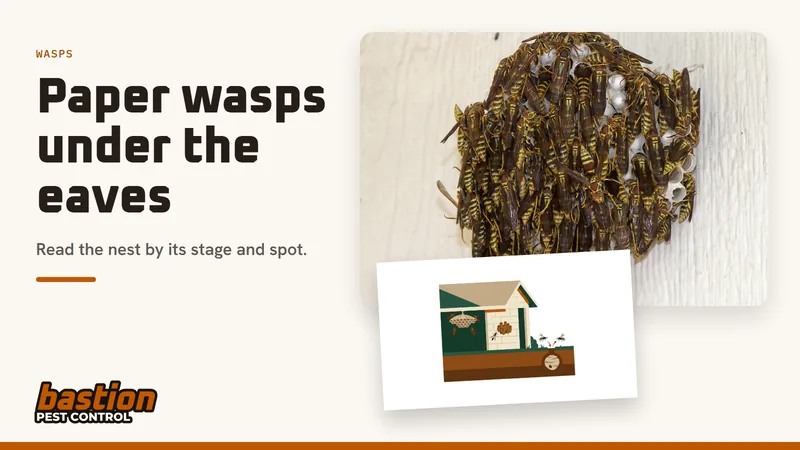
A paper wasp nest is an open paper comb, usually under the eaves, started in spring by a queen that spent the winter in a crack in a building. In Austin that start can come in March. A nest by a door, a mailbox or a playset is a job, and one out of the way can stay.
Summary
The short answer
A paper wasp nest is an open comb with no paper envelope. Mated queens spend the winter in cracks in buildings or under bark. Austin's average last freeze is February 15. The colony reaches peak size in late summer to early fall. A nest by a door, a mailbox or a playset needs handling. One where nobody will bump it can stay for the caterpillar control.
Wizzie Brown, the Texas A&M AgriLife entomologist in Austin, puts the peak in late summer to early fall and told KXAN a nest by a door or a mailbox needs taking care of. With the last freeze in mid-February, per the National Weather Service, spring nests can start in March, by our reading.
Prefer to listen? 52 seconds.
The short version, read aloud. Read by a synthetic voice, not one of our technicians.
How to tell a paper wasp nest from a yellowjacket or mud dauber nest
A paper wasp builds an open, umbrella-shaped comb of paper cells that hangs from a single filament, with no envelope around it, most often under the eaves. Texas A&M's Apiary Inspection Service describes it as chewed wood fiber in one tier of hexagon-shaped cells.
- The wasp is slender. Paper wasps are 3/4 to 1 inch long and narrow-waisted, with smoky black wings. Polistes exclamans is brown with yellow markings, and Polistes carolina, the "red wasp," is reddish-brown all over.
- A yellowjacket nest is closed. It is completely enclosed in an envelope except for one entrance hole, E-239 says, and the wasp's waist is barely visible. Brown says the two get mixed up because certain paper wasps also have yellow stripes on reddish-brown bodies.
- A mud dauber nest is mud. UC IPM describes a dark, thread-waisted wasp that rarely stings, and since it does not defend its tubes, Texas A&M's E-239 wasp guide says you can scrape them off with a putty knife.
The clip below walks through all three with Austin's AgriLife entomologist.
Why queens can show up in March
A paper wasp colony normally lives one season. In fall, the mated daughters look for winter shelter, and the rest of the colony dies off over the winter. E-239 says the queens favor high spots such as peaked attics and chimneys, and Penn State notes that queens wintering in walls can get turned around and come indoors in spring.
They pick a nest site in spring, and in Austin the average last freeze is February 15 and the normal March high is 73.3 F. No source gives a measured start date here, so March is our reading of that weather.
The calendar lays the year over Austin's freeze-free months. For other pests, see the Austin pest calendar.
The paper wasp year in Central Texas
Each stage as the Texas sources put it, laid over Austin's average freeze-free months.
- Season named by the source
- Austin's average freeze-free stretch, 1991 to 2020
A spring comb and a late-summer comb: same nest, different job
The spring nest is small. A queen that starts a nest by herself works alone until her first daughters emerge, gathering wood fiber, laying eggs and hunting caterpillars for her brood, Mississippi State's Blake Layton writes. Early queens sometimes share a nest, E-239 says, but by midsummer there is usually one egg-layer.
Then it grows through summer, peaks in late summer to early fall and raises males and new queens. Even then, it is small next to a big yellowjacket nest.
Thousands of wasps is a yellowjacket number
A paper wasp nest against a Texas southern yellowjacket nest. Each pair is drawn to its own scale, with the yellowjacket at full width.
- Paper wasp
- Southern yellowjacket, in Texas
Next spring brings a new nest. The Apiary Inspection Service says the empty one is never reused, but E-239 adds that new nests often go up in the same general spot.
When a nest is a job
Where the nest is decides whether it is a job. Brown says wasp nests in an area that won't be disturbed typically are not going to be an issue, while one by the front door or on a kids' playset is a concern. UC IPM agrees that paper wasp nests shouldn't require treatment unless they are near people.
When one must go, go early: Layton says it is much better to take out a problem nest while it is small than once it is hat-sized with dozens of wasps.
A nest you can leave is worth leaving. Paper wasps feed their young caterpillars, flies and beetle larvae, and many gardeners count them as beneficial insects.
| Stage | When in Austin | What you see | What to do |
|---|---|---|---|
| Winter shelter | Fall and winter, out on warm days | A wasp indoors, or a cluster of queens in the attic; not a nest | Release it outdoors or use a fly swatter; overwintering wasps are not aggressive |
| Founding nest | Spring, from about March | A founding queen, sometimes with others, on a small comb that reaches a dozen or more cells by late spring | Out of the way: leave it. By a door: knock it down early, and again if she rebuilds |
| Growing nest | Late spring into summer | Daughters emerge and the comb grows fast | Out of the way: leave it. Near people: treat at dusk, or call |
| Peak colony | Late summer to early fall | Dozens of wasps on a comb they defend when disturbed | By a door, a mailbox or a playset: it needs handling, usually by a professional |
Fix it yourself or call
A founding queen on a small comb is often a broom job: UF/IFAS says to knock it down, and she will likely start elsewhere. Iowa State warns she may rebuild, and Brown suggests repeated early knockdowns, not once the nest is larger with several wasps.
- Go at dusk or dawn. The colony rests on the nest at night, so E-239 says treat in the late evening and Brown says early morning or just before dark.
- Stand back, not under it. Brown recommends a spray with a concentrated stream of 8 to 10 feet. Most aerosol wasp and hornet sprays make the insects drop instantly, Kentucky warns, so standing directly under the nest raises the risk of a sting.
- Wait, then clean. Leave the nest up until the wasps are dead, which can take up to 2 days. Then take it down and clean the spot of pheromones that might draw other wasps, Brown says.
Wasp fixes that backfire
- Gasoline or the garden hose. Kentucky calls both folk remedies that are seldom successful and can bring multiple stings. Penn State says a jet of water from a safe distance works on a hanging nest in spring and early summer, while building is just starting and no adult wasps are on the nest.
- Fake nests and traps. Hanging artificial nests has not been shown to work, Iowa State says, and trap lures seldom attract every paper wasp species.
- A heart condition or a venom allergy. E-239 says anyone with either should not attempt wasp control.
General information, not medical advice. A whole-body reaction to a sting needs emergency care immediately.
For a busy nest by a door, a mailbox or a playset, E-239's general advice applies: wasp control is usually best left to professionals.
Our general pest plan covers wasps, so eaves, soffits and overhangs get treated on every visit, and a nest that turns up between visits comes down free. For homes not on a plan, taking down an active nest is $299, currently from $199. See wasp control and pricing.
Common questions
Why are there paper wasps in my house in winter?
Usually it is a queen that was wintering in a crack in the house. Brown told Texas Standard that a sunny, warm winter day can fool one into thinking spring is here, and she dies when she finds no food. Overwintering paper wasps are not aggressive, E-239 says, so release her outdoors or use a fly swatter.
Are paper wasps aggressive?
Rarely, away from the nest. UC IPM calls them much less defensive than yellowjackets, and Cornell says they often warn intruders by flying into them without stinging. But all social wasps defend a disturbed nest. If you are attacked, E-239 says, cover your head and run to a building or a car.
How bad is a paper wasp sting?
Usually local pain and swelling, the Texas A&M field guide says, but whole-body reactions can follow in sensitive people or after many stings. Only females sting, and wasps leave no stinger, so one can sting again. About 5 percent of people with a large local reaction will have anaphylaxis if stung again, E-239 (2003) says.
What if it is honey bees, not wasps?
Paper wasps are not fuzzy like bees and have an obvious waist and long legs, Cornell says, and UC IPM says honey bees are hairier and less brightly striped than yellowjackets. We never treat honey bees. We identify the colony and refer you to a beekeeper for live removal, and the referral is free. Our bee control page explains how it works.
Not sure what is building on your eave?
Text a photo of the nest to 843-480-8699, or call and describe the nest and the traffic. We can usually tell you whether it needs same-day attention.
Call 843-480-8699 Phone answered 24/7. Same-day service most days.Sources
- Texas A&M Entomology Research Network, Insect of the Month: Paper Wasps
- KXAN Austin, Here's when wasp season wraps in Central Texas
- National Weather Service Austin/San Antonio, Austin Climate Summary (PDF)
- Texas A&M AgriLife Research, Texas Apiary Inspection Service, Paper Wasps
- Texas A&M AgriLife Extension, Field Guide to Common Texas Insects, Paper Wasp
- University of California Statewide IPM Program, Pest Notes: Yellowjackets and Other Social Wasps
- Penn State Extension, Five-Step Decision Support: Nesting Bees and Wasps Near Homes
- NOAA National Centers for Environmental Information, U.S. Climate Normals 1991-2020, Austin Camp Mabry (CSV)
- Texas A&M AgriLife Extension Service, Paper Wasps, Yellowjackets and Solitary Wasps (E-239) (PDF)
- Mississippi State University Extension, Bug's Eye View: Paper Wasp Queen
- Texas A&M AgriLife Extension, Insects in the City, Fascinating facts about wasps and hornets
- UF/IFAS Extension EDIS, Paper Wasp, Red Wasp, Polistes carolina (EENY640)
- Iowa State University Extension and Outreach, Early Season Wasp Management
- University of Kentucky Entomology, Controlling Wasps, Hornets and Yellowjackets (ENTFACT-620)
- Penn State Extension, Common Social Bees and Wasps of Pennsylvania (PDF)
- Texas Standard, interview with Wizzie Brown on wasps indoors in winter
- Cornell CALS, New York State IPM Program, Paper Wasps
Answered 24 hours · Austin, TX
A nest under the eaves?
Text a photo of the nest to 843-480-8699. We can usually tell a paper wasp comb from a yellowjacket or mud dauber nest from the picture, and tell you whether it needs same-day attention.