Moles in Texas
Moles in Texas, gophers or grubs? What is making the dirt piles in your yard
Moles in Texas leave raised ridges along with their mounds, while a horseshoe-shaped mound with no ridges is a pocket gopher. Root-feeding white grubs mostly leave brown turf instead, and fire ants, armadillos and crawfish leave their own mounds and holes.
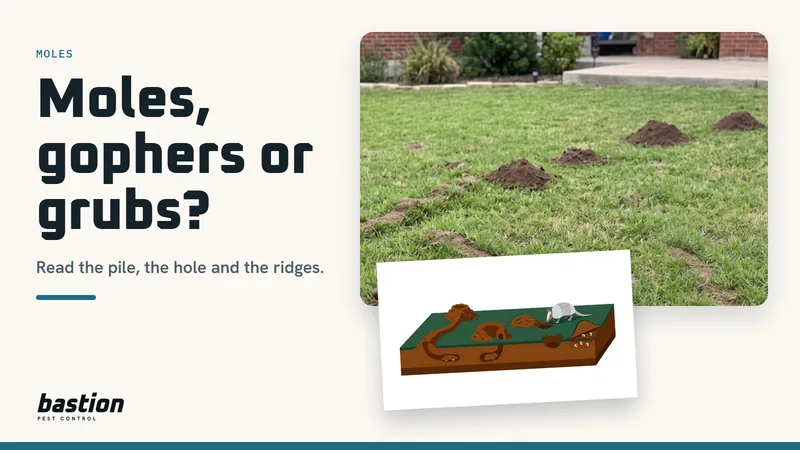
The short answer
- Raised ridges
- Mole feeding tunnel
- Horseshoe mound, plug to one side
- Pocket gopher
- Fluffy mound, no center hole
- Fire ants
- Shallow open holes
- Armadillo feeding
- Brown turf that peels up
- Root-feeding white grubs
Moles in Texas push up conical mounds and meandering raised ridges, according to Mammals of Texas. Pocket gophers do not make the ridges, UC IPM says, so the ridge is the fastest check.
Prefer to listen? 52 seconds.
The short version, read aloud. Read by a synthetic voice, not one of our technicians.
Three checks that tell you what dug your yard
Moles in Texas leave raised ridges along with their mounds, pocket gophers leave horseshoe-shaped mounds with no ridges, and root-feeding white grubs mostly leave brown turf instead. Check the freshest pile for three things.
- The pile's shape. A mole mound is circular or volcano-shaped with the plug in the middle, though the plug may not be apparent. A gopher mound is a half circle or horseshoe.
- An open hole, or not. A gopher's hole sits off to one side of the mound and is usually plugged. Armadillo feeding holes and crawfish chimneys are open.
- Raised ridges, or not. A winding raised ridge is a mole's shallow feeding tunnel, and gophers do not make them. One catch: AgriLife's turf damage table credits a thin S-shaped trail about 1/2 inch wide to mole crickets.
The drawing puts five culprits in one Central Texas yard, and the table lines up six, with who handles each one.
| Culprit | Mound shape | Open hole | Raised ridges | What it eats or does | Who handles it |
|---|---|---|---|---|---|
| Mole | Circular or volcano-shaped, 2 to 12 in tall | Plug in the center, may not be visible | Yes, winding ridges | Earthworms, grubs, beetles, insect larvae | We do: bait in the active tunnels |
| Pocket gopher | Horseshoe or half circle, 8 to 24 in across, 6 in high | Plugged, off to one side | No | Fleshy roots, tree roots included | Not the same job as moles; text us a photo to confirm which it is |
| White grubs | Usually no pile; brown turf that can roll up like a carpet | No | No | Grass roots | Lawn care; follow Texas A&M E-211 |
| Fire ants | Fluffy worked soil, a few inches tall in lawns | No center opening | No | Mound most noticeable a few days after heavy rain | We do: ant control |
| Armadillo | No mound; shallow feeding holes 3 to 5 in wide | Yes | No | Digs for insects | Wildlife; we refer it out |
| Crawfish | Mud chimney that can reach several inches tall | Yes, about 1/2 in center hole | No | Can become numerous in poorly drained soil | Better drainage may reduce activity; no pesticide is registered or recommended |
Mole vs gopher, and why one hunts worms while the other eats roots
Texas has one mole, the eastern mole (Scalopus aquaticus), and it eats mainly earthworms, grubs, beetles and insect larvae. The pocket gopher is a different animal. Texas A&M's pocket gopher leaflet calls moles insectivorous and warns that their mounds sometimes resemble a gopher's, while the gopher eats mainly fleshy roots, trees included.
That difference decides the fix. An insecticide for grubs does nothing to a gopher, because gophers feed on plants, as UC ANR's extension FAQ notes.
The first half of the clip below shows how mole and gopher mounds and tunnels differ.
Mole or gopher? Send a photo
Gophers and moles are not the same job, and treating for the wrong one wastes your money. Text a photo of the mound to 843-480-8699.
Mounds and holes in the yard that are not moles or gophers
Three other culprits leave mounds or holes, and none of them makes ridges.
- Fire ants. Texas A&M's fire ant project describes a mound of fluffy worked soil with no center opening, seen particularly a few days after heavy rain. We treat these under ant control.
- Armadillos. No mound, just shallow feeding holes dug in search of food, and more than 90 percent of an armadillo's diet is insect matter. Grub-infested turf may also be dug up by armadillos, skunks and raccoons. Armadillos are wildlife, and we refer wildlife jobs out.
- Crawfish. Mud chimneys that can reach several inches tall in poorly drained soil. They do not harm turf, no pesticide is registered or recommended for them, and improving drainage may reduce their activity.
Width helps with close calls. The gopher mound is the widest thing on the chart, and a mole's feeding tunnel is narrower than a gopher's.
Measure the pile, then the hole
Published widths for the mounds, holes and tunnels found in Texas yards. Inches.
- Dug by a mammal
- Built by insects, worms or crawfish
Do grubs make dirt piles?
Mostly no. White grubs, the larvae of May and June beetles, feed on roots, so Texas A&M's E-211 guide describes brown turf that loses vigor and, when badly damaged, can be rolled up like a carpet.
The exception in the same guide is the green June beetle. Its larvae feed mainly on decaying organic matter. Their daytime resting places, near heavily mulched or organic-rich spots, are marked by small soil mounds on the lawn.
Grubs are a lawn-care call, and E-211 is the guide to follow. It says more than five grubs per square foot justifies treatment and puts the central Texas window in early to mid-July. Spring and winter treatments for 1-year grubs generally do not prevent turf damage.
The timeline shows the split: grub damage runs from summer into fall, while moles and gophers are most active in spring and fall. For every other pest, see the Austin pest calendar.
Which digger is busy this month
When each one shows up in Texas, as the sources put it. The gopher and grub rows are statewide ranges.
- Months named by the source
- Season named by the source
- Wider window named by the source
Austin soil splits at I-35, limestone west and clay east
In Austin, Travis County AgriLife says I-35 helps separate the Edwards Plateau from the Blackland Prairie: thin soils over limestone to the west, black and reddish clays to the east. Along the river bottoms and the broad plains southeast of the city, the soils are often deep sandy loams.
Mammals of Texas places the eastern mole across the eastern two-thirds of the state, largely in moist, sandy soils, and says deep dry sands and heavy clays are avoided.
No source maps moles or gophers to Austin soils, so treat this as background, not a map of where moles live.
What you can fix yourself, and when to call
You can do the ID yourself, and for grubs or a crawfish chimney the fix does not involve us at all. For moles, ICWDM calls trapping the most successful and practical method, and the popular fixes below mostly miss.
Mole fixes that do not hold up
- Vibrating stakes and sonic spikes. ICWDM says no frightening device has been proven effective against moles, pinwheels included.
- Gum, glass and gasoline. The same page lists chewing gum, rose thorns, broken glass, used cat litter, gasoline and ammonia as proven ineffective, and some may be environmentally hazardous.
- Castor oil, with limits. ICWDM reports minor effectiveness in repelling moles, but UC IPM notes that repelled moles simply move to neighboring lawns.
- Grain baits. Texas A&M's L-1905 mole leaflet says grain baits usually fail because moles normally do not eat grain. That verdict is about grain, not every bait.
It outgrows DIY when fresh ridges keep crossing the lawn. Our mole control is bait placed directly inside the active tunnels, below ground. It is $333 a stop with a three-stop minimum, so $999 for a lot up to half an acre, with thirty days between stops.
Each extra half acre adds $30 a stop, and if three stops have not settled it, the fourth is free. It is a set job, not part of the monthly plan. These are starting prices; your exact number depends on home size, lot size and current pest pressure. See pricing, or the full list of services.
Common questions
Are moles rodents?
No. UC IPM says moles are not part of the rodent family, and Mammals of Texas files the eastern mole in the family Talpidae. The rodent in this story is the pocket gopher, which Texas A&M's pocket gopher leaflet calls a burrowing rodent. The gopher eats roots, and the mole hunts worms and insect larvae.
Will killing the grubs get rid of moles?
Not reliably. ICWDM says a lawn can be free of grubs and still have moles, because moles also feed on worms and ants. Texas A&M's mole leaflet adds that once the food supply drops, moles may dig more before they leave, so the lawn can look worse for a while. Treat grubs for the grass, not for the moles.
How many moles are in my yard?
You cannot count them from the mounds. ICWDM says the number of hills does not correspond to the number of moles in an area. Moles need a large area to feed, and Texas A&M AgriLife counts three to five moles per acre as a high population for most areas.
What makes small round holes in my lawn?
Dime-sized holes can be cicada killer wasps. Texas A&M's urban entomology team describes females digging in home lawns or any sandy, bare, well-drained soil in full sun, and Williamson County AgriLife says they burrow in July and August. Travis County AgriLife calls them native and rarely aggressive, and says they usually do not warrant any control.
Not sure what dug it?
Text a photo of the mound or ridge to 843-480-8699. We can usually confirm mole versus gopher from the picture, and we will tell you whether you need us at all.
Call 843-480-8699 Phone answered 24/7. Same-day service most days.Sources
- Texas Tech University Natural Science Research Laboratory, The Mammals of Texas, Eastern Mole
- University of California Statewide IPM Program, Pest Notes: Pocket Gophers
- UC Agriculture and Natural Resources, Pests in the Urban Landscape, FAQ: Moles, Voles and Gophers
- Texas A&M AgriLife, Texas Imported Fire Ant Research and Management Project, Damage Symptoms of Common Turfgrass Pest Problems and Possible Causes
- Internet Center for Wildlife Damage Management, Mole Damage Identification
- Texas A&M AgriLife Extension Service, Wildlife Services, Moles (L-1905) (PDF)
- Texas A&M AgriLife Extension Service, Wildlife Services, Managing Pocket Gopher Damage (L-1904) (PDF)
- Texas A&M AgriLife, Texas Imported Fire Ant Research and Management Project, FAQ
- Texas A&M AgriLife, Texas Imported Fire Ant Research and Management Project, How can I tell if I have fire ants?
- Internet Center for Wildlife Damage Management, Armadillo Damage Identification
- Texas A&M AgriLife Extension Service, Wildlife Services, Armadillo (L-1906) (PDF)
- Texas A&M AgriLife, AggieTurf, White Grubs
- Texas A&M AgriLife, Landscape IPM, Crawfish
- Internet Center for Wildlife Damage Management, Mole Biology
- Texas A&M AgriLife Extension, White Grubs in Texas Turfgrass (E-211) (PDF)
- Texas A&M AgriLife Extension, Williamson County, Cicada Killer
- Texas A&M AgriLife Extension, Travis County, The Real Dirt on Austin Area Soils
- Internet Center for Wildlife Damage Management, Mole Damage Prevention and Control Methods
- University of California Statewide IPM Program, Pest Notes: Moles
- Texas A&M AgriLife Extension, Insects in the City, The Texas-sized cicada killer
- Texas A&M AgriLife Extension, Travis County, Cicada killer wasps
Answered 24 hours · Austin, TX
Dirt piles in the yard?
Text a photo of the mounds and ridges to 843-480-8699. We can usually tell a mole from a gopher, fire ants or an armadillo from the picture, and tell you whether it is a mole job before anyone walks the yard.