Termites and ants
Termite or ant? How to tell swarmers apart
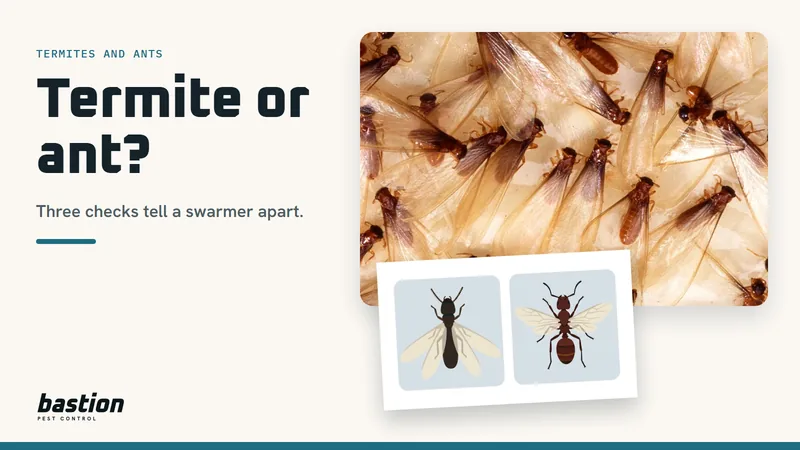
A termite swarmer has straight, beadlike antennae, a thick waist and four wings of equal length. A flying ant has elbowed antennae, a pinched waist and front wings longer than its back pair. Here is how to run all three checks in a minute, when each swarmer flies in Central Texas, and who to call for each.
The short answer
- Antennae
- Termite straight and beadlike, ant elbowed
- Waist
- Termite thick, ant pinched
- Wings
- Termite four equal, ant front pair longer
- Who to call
- Termites: a termite-licensed company. Ants: us
The termite vs ant call takes three checks: the waist, the antennae and the wings. Termites swarming indoors are an almost sure sign of infestation, but the swarmers cannot damage wood and live about a day.
Prefer to listen? One minute 20.
The short version, read aloud. Read by a synthetic voice, not one of our technicians.
Termite vs ant: the ten-second answer
Check the waist first: a termite swarmer is thick through the middle, with straight, beadlike antennae and four wings of equal length, while a flying ant has a pinched waist, elbowed antennae and front wings longer than its hind wings. If termites came out indoors, call a termite specialist. If they are ants, the stakes drop.
| Test | Termite swarmer | Flying ant | Source |
|---|---|---|---|
| Waist | Thick, "abdomen broadly joined to thorax" | Pinched, "distinctly pinched waists" | Mississippi State, ENT-2012 |
| Antennae | Straight and "beadlike," no elbow | Elbowed, bent "at a ninety-degree angle" | Texas A&M field guide, Travis County AgriLife |
| Wings | Four "long, equal-length wings" | Four, "two long and two relatively short" | ENT-2012 |
| Wing veins | Wings "tend to have a lot of veins" | "All wings will have few veins" | Travis County AgriLife |
| After the wings drop | "Wing stubs, called 'scales'" left on the thorax | Sheds wings too, so fall back on the waist and antennae | Travis County AgriLife, ENT-2012 |
Stop at the first clear answer. For flying ants vs flying termites, the waist works best on a live insect, and veins help most with a loose wing.
What do termites look like next to a flying ant?
The termite on your windowsill is a winged reproductive, also called a swarmer or alate. Flying ants vs termites comes down to marks a phone camera can catch. Photograph the insect on a white paper towel and zoom in.
Size is not one of the tests. The ranges overlap.
Size will not settle it
Published body lengths of the swarmers you might find in Central Texas. The ranges overlap.
- Termites
- Ants
- Both, general range
When do termite swarmers and flying ants show up in Central Texas?
Termite swarmers in Texas can fly in any month, but Texas A&M says swarms are most common from February to May. No source we found gives Travis County months, so the clock below uses the statewide ones.
The Central Texas swarm clock
When each swarmer flies, and at what time of day, as the Texas sources put it.
- Months named by the source
- Season named by the source
- Wider window named by the source
Formosan termites swarm at night, and Travis County is on Texas A&M's detection list for them. The same page says there is little chance of encountering them outside the upper Gulf Coast. The rest of the year's pests are in our Austin pest calendar.
Where it swarmed matters more than what it was
Does a termite swarm mean the house has termites? It depends on where it came out.
Inside the house
A few swarmers can drift in from outside, but Texas A&M still calls indoor swarmers a reliable signal of infestation. Killing swarmers is optional clean-up, not a termite treatment.
Out in the yard
Finding termites in a fence or woodpile does not necessarily mean the house needs treatment. Check the foundation for mud tubes anyway.
What waiting costs
University of Kentucky entomologists say the damage from taking "an additional day, week, or month" to decide is generally inconsequential, and the TDA is blunter: "Do not panic."
Years are different. Subterranean termites cause about $500 million in damage in Texas each year, and Texas A&M rates the chance of damage within 25 years for an unprotected home as "very high." Termite damage is also not typically covered by homeowner's insurance, per a 2016 AgriLife Today report.
If it was ants
In most cases, an indoor flight with no workers before it should not be a cause for concern, and fire ant swarmers indoors usually indicate an outdoor nest against the foundation.
Workers that keep coming back are a colony problem, and that is the part we handle through ant control. A technician traces the flight to its source and treats the colony rather than the flyers. Ant control in Austin covers the local side, and our services page shows what a plan includes.
Carpenter ant vs termite damage looks nothing alike
The carpenter ant vs termite question is often easier to settle from the wood than from the insect. Carpenter ants do not eat wood. They nest in it and push the waste out, and Texas A&M says they generally are not as damaging as termites.
- Frass under a small hole. Carpenter ant frass is wood shavings plus tiny fragments of dead ants and other insects.
- Clean, smooth tunnels. Carpenter ant galleries usually follow the grain, and the walls are clean and smooth.
- Mud-lined galleries. Termite-damaged wood is hollowed out along the grain, with bits of dried mud or soil lining the galleries.
- Mud tubes. Earthen shelter tubes on piers, near utility openings, or on foundation walls and slabs are a sign of termite infestation.
What to do in the first 24 hours after termites swarm inside
Found flying termites in the house, at a window or around a light fixture? Work through these in order.
- Keep a few, intact. The Texas Department of Agriculture (TDA) suggests you save several of the swarmers in a plastic bag for the inspector. Photograph them or put the bag in the freezer.
- Note where they came out. The room, the wall, the window or the crack.
- Vacuum the rest. They will not live past about a day anyway.
- Walk the foundation. Look for mud tubes on the slab edge, on piers and around utility openings.
- Call a termite-licensed company. In Texas that is the Termite and Wood Destroying Insect Control category.
- Check the license by phone. The TDA's Structural Pest Control Service will confirm a company's license by phone at (866) 918-4481.
What not to do after an indoor swarm
- Do not crush them. The waist and antennae are the evidence.
- Do not sign in the driveway. There is time to compare two inspections.
- Do not rule out termites because there are no wings. Check for wing scales and a thick waist.
We do not do termite work, and we say so up front. Termite jobs go to a company licensed by the TDA in the termite category. Our Austin pest control cost guide covers what termite specialists and wood destroying insect (WDI) reports involve.
For an answer from someone with nothing to sell, Travis County AgriLife Extension helps identify swarmers at 512-854-9600.
Common questions
What do termite wings on a windowsill mean?
If they are termite wings, termites swarmed inside, an almost sure sign of infestation. Check one wing to be sure: termite wings are similar in size and heavily veined, while ant wings are unequal with few veins. Maryland Extension describes the termite sign as piles of silvery, membranous insect wings, all about 1/4 inch long, on floors, windowsills or in spider webs.
Are flying ants a sign of termites?
No. Flying ants are ant reproductives on a mating flight, a different insect with elbowed antennae and a pinched waist.
Do termites swarm at night?
Some do. Native subterranean termites swarm in daylight during the spring, usually after rain. Formosan termites swarm at night in late May and early June and are attracted to lights.
Are carpenter ants as bad as termites?
Generally, no. Their damage is usually limited, because they tunnel rather than feed. Indoors, the frass under a small hole tells you more than the ant does.
Winged insects on the windowsill right now?
Call and tell us where they came out, or send a sharp photo through the contact form. Ants, we handle. Termites, we will say so and show you how to check a termite company's license.
Call 843-480-8699 Same-day service most days.Sources
- Texas A&M AgriLife Extension, Swarming Insects Indoors (ENT-2012)
- Texas A&M AgriLife Extension, Frequently Asked Questions About Subterranean Termite Control (ENT-2002)
- Texas A&M AgriLife Extension, Insects in the City, What is a termite?
- Texas A&M AgriLife Extension, Subterranean Termites (ENTO-PU-036)
- Texas A&M AgriLife Extension, Carpenter ants around homes (ENT-2001)
- Texas A&M AgriLife Extension, Travis County, Ants and Termite Swarmers ID
- Texas A&M AgriLife Extension, Travis County, Carpenter Ants May Be a Problem This Year
- Texas A&M Urban and Structural Entomology Program, Native Subterranean Termites
- Texas A&M Urban and Structural Entomology Program, Formosan Termites
- Texas A&M AgriLife, Field Guide to Common Texas Insects, Isoptera
- Texas A&M AgriLife, Field Guide to Common Texas Insects, Termite
- Texas A&M AgriLife, Field Guide to Common Texas Insects, Carpenter Ant
- Texas A&M AgriLife, Field Guide to Common Texas Insects, Texas Leafcutting Ant
- Texas Imported Fire Ant Research and Management Project, Fire ant biology
- AgriLife Today, Expert: Beware of insect pests that can reduce your home's value (2016)
- Texas Department of Agriculture, Structural Pest Control Service, Termite FAQs
- Texas Administrative Code, 4 TAC 7.124, via Cornell LII
- University of Kentucky Entomology, Termite Control: Answers for Homeowners (ENTFACT-604)
- Mississippi State University Extension, Are These Termites or Ants?
- University of Maryland Extension, Termites
Answered 24 hours · Austin, TX
Found winged insects inside? Send us a photo.
One sharp close-up is usually enough. If they are ants, we will tell you which kind and what we would do. If they are termites, we will say so and point you to a licensed termite company, because termite work is not a job we take.