Bed bugs
What do bed bugs look like?
An adult bed bug is about the size of an apple seed. Flat, oval, reddish brown, and no wings. The young ones are the problem, because they are nearly clear and the size of a comma. Here is every stage next to a ruler, the marks they leave on a mattress, and the six insects people bring us thinking they found one.
The short answer
- Adult length
- 3/16 to 1/4 inch
- Roughly the size of
- An apple seed
- Body
- Flat oval, no wings
- Color, hungry
- Brown
- Color, just fed
- Dark red, swollen
- Egg
- About 1 mm, pearl white
An adult bed bug is 5 to 7 mm long, oval from above and flat from the side, in a plain reddish brown. It has no wings, it cannot fly, and it cannot jump. After a meal it swells, stretches out and turns dark red, so two bed bugs on the same mattress can genuinely look like two different insects. The young are 1.5 mm and close to transparent. Most people find the stains long before they find the bug.
Prefer to listen? One minute 26.
The short version, read aloud. Read by a synthetic voice, not one of our technicians.
You woke up with a line of marks on your forearm, you have been reading about it for forty minutes, and now every dark speck on the sheet looks like something. That is where most people are standing when they search this.
So here is the picture, at every size it comes in, and then the six other insects that get mistaken for it.
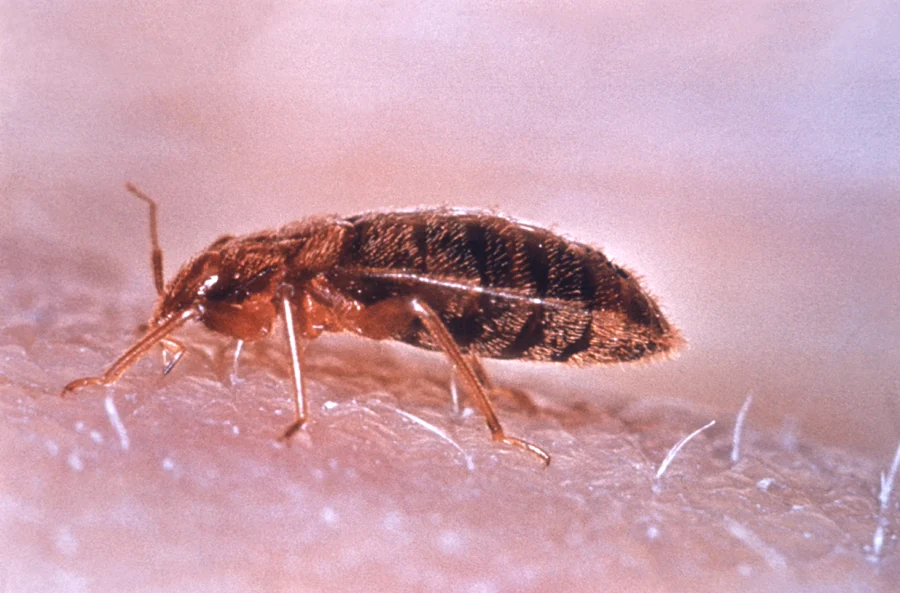
What an adult bed bug looks like: an apple seed that walks
The EPA describes an adult bed bug as about the size of an apple seed, 5 to 7 mm, long and brown, with a flat oval body when it has not fed recently. Texas A&M's Urban and Structural Entomology Program puts the same insect at about 1/4 inch, reddish brown, with an oval flattened body. The University of Kentucky adds a comparison that lands better for most people: the shape is like an apple seed, but the size is closer to a lentil.
Four things separate it from almost everything else you will find in a bedroom.
- It is flat. Not flat like a beetle, flat like a sheet of paper standing on edge. That shape is why it fits in a mattress seam and behind a headboard screw.
- It has no wings. There are small wing pads behind the head and nothing else. The University of Kentucky is blunt about it: bed bugs do not fly, or jump like fleas, but they crawl quickly over floors, walls and ceilings.
- It is one plain color. Brown, going redder after a meal. No spots, no bands, no pattern.
- It is covered in short golden hairs. You need a phone camera zoomed in to see them, but the EPA lists them, and they are the reason a bed bug looks slightly fuzzy at high magnification rather than shiny.
What it looks like after it feeds
Different insect, same bug. The EPA describes a recently fed adult as balloon-like, reddish brown, and more elongated. Texas A&M's own bed bug page leads with a photo captioned simply that human bed bugs change shape and color as they feed.
This is the single most common reason people decide they have two different pests. The hungry one is a flat brown disc. The fed one is a plump, dark red, stretched oval that looks swollen enough to pop. They are the same species, often the same night.
It matters for a practical reason too. A fed bug is no longer flat, so it cannot get back into the tightest cracks, and it will often shelter somewhere slightly more open. That is frequently the one you actually see.
At rest. Flat and compact.
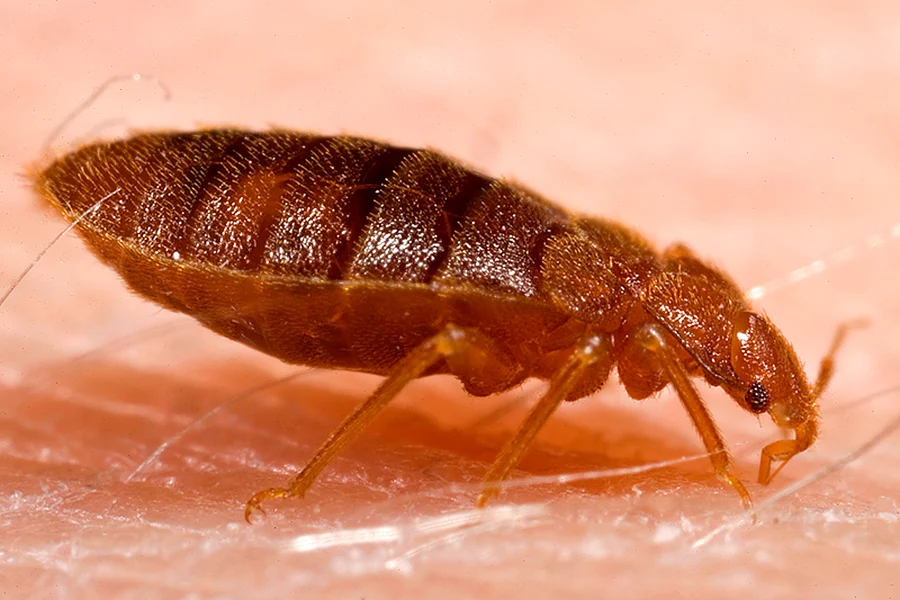
Mid-meal. Swollen and stretched.
Bed bug nymphs and eggs, which is what you will actually miss
A bed bug grows through five nymph stages, and it needs a blood meal before each molt. The EPA publishes the size of every one of them, which makes this the rare pest question with an exact answer.
Bed bug size, egg to adult
Millimeters. The first three stages are smaller than a grain of salt.
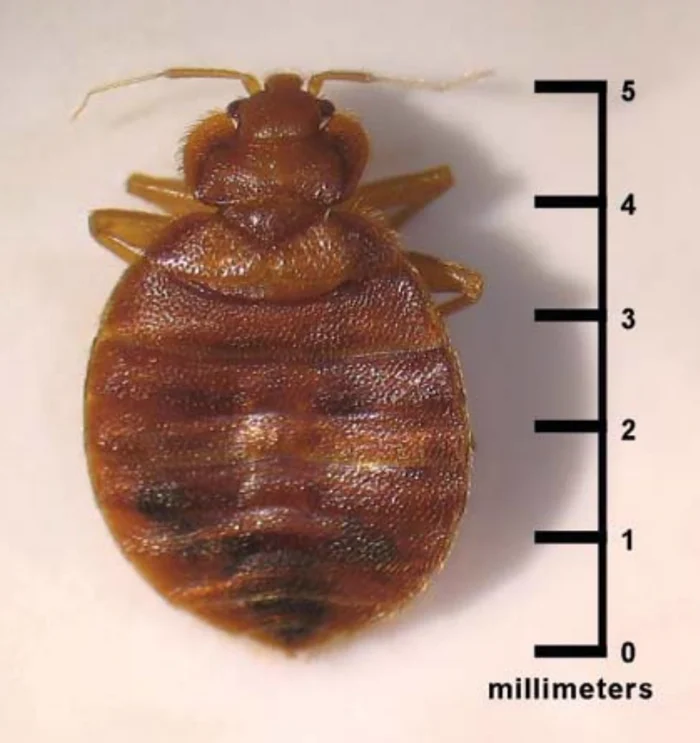
The EPA says young nymphs are translucent or whitish yellow, and can be nearly invisible to the naked eye. That is the honest reason a self-inspection comes back clean and the problem does not go away. You were looking for a brown apple seed. What was there was a clear speck the width of a pencil line.
Eggs are about 1 mm, pearl white, and sticky when they are laid, so they sit glued into seams and screw holes rather than loose. The EPA notes that an egg more than five days old has a visible eye spot. Texas A&M records a female laying around 200 eggs in her lifetime, at three or four a day, hatching in 6 to 17 days.
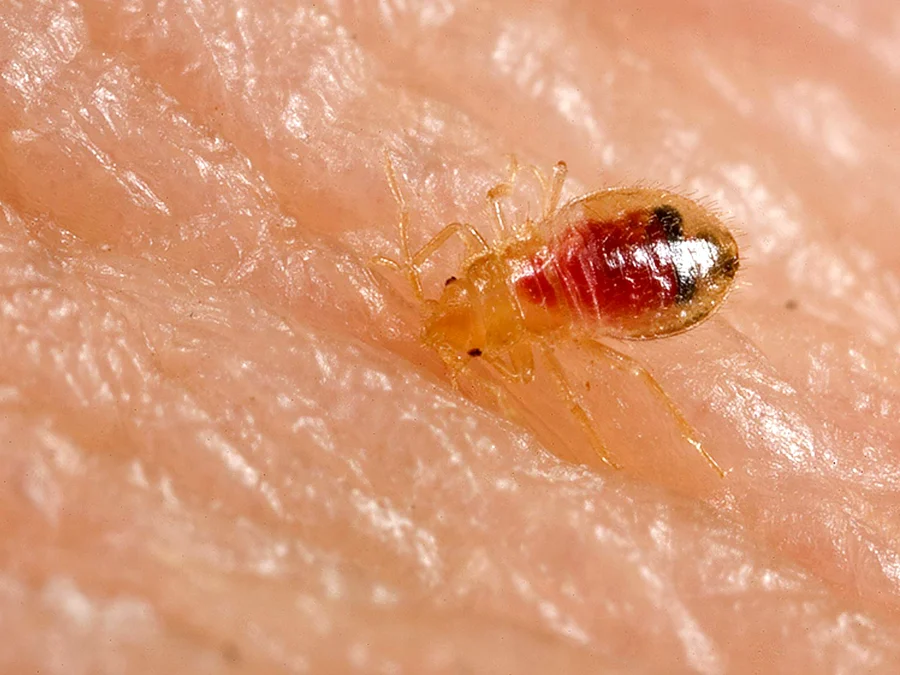
A nymph. Clear, except for the meal.
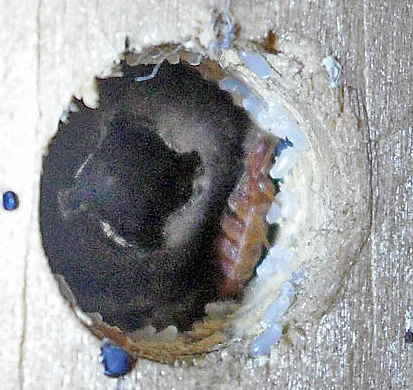
Eggs, glued into a screw hole.
What they leave behind, which you will see first
Almost nobody finds the insect first. They find a mark and then go looking. The EPA's list of signs is short and worth knowing by heart.
| What you see | What it is | Where it shows up |
|---|---|---|
| Rusty or reddish smears | A bug crushed while you rolled over | Sheets, mattress top, pillowcase |
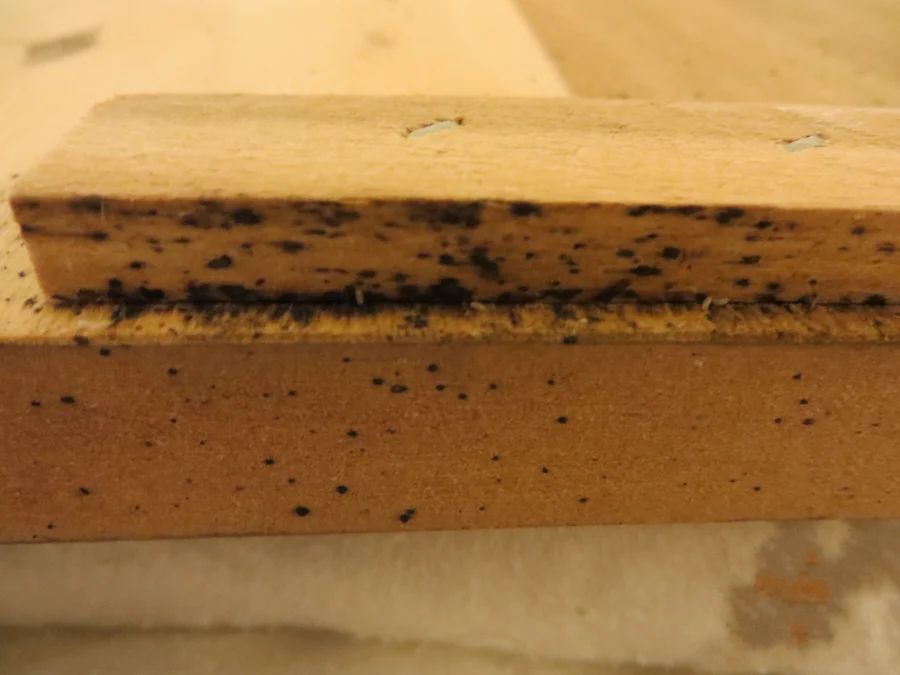
| Dark spots the size of a period | Excrement. It bleeds into fabric like felt pen ink | Piping, seams, the sides of the box spring |
| Pale yellow empty shells | Shed skins, one per molt, five per bug | Seams, headboard joints, under the mattress tag |
| Tiny pearl white grains | Eggs, about 1 mm, glued in place | Cracks, screw holes, fabric folds |
| A musty, sweetish smell | Scent glands, and it takes a lot of bugs to notice | The room itself, not one spot |
The dark spots are the most useful of these, because they are hard to fake and easy to test. A bed bug spot is digested blood, so it soaks into fabric and spreads slightly at the edges. Dirt sits on top and brushes off. If a damp white cloth pulls a rusty smear out of the spot, that is a real sign.
Six bugs that look like bed bugs
This is the part that actually saves people money. The EPA leads its own control advice with it: make sure you really have bed bugs, not fleas, ticks or other insects. We have been called out to all six of the following, and three of them needed no treatment at all.
| What it is | What gives it away | Where you find it |
|---|---|---|
| Bat bug | The fringe hairs just behind the head are longer than the eye is wide. On a bed bug they are shorter | Attics, wall voids, chimneys. Follow it up, not down |
| Swallow bug | The last two antenna segments are nearly the same length. On a bed bug the last is about half the one before it | Under eaves, near mud nests on the outside wall |
| Carpet beetle larva | Hairy, not smooth. Banded light and dark brown, with a tuft of long hairs at the tail | Carpet edges, closets, under furniture, in wool |
| German cockroach nymph | Two dark stripes running lengthwise down the back. A bed bug has no stripes at all | Kitchens and bathrooms, near warmth and water |
| Tick | Eight legs once mature, and it stays attached to skin. A bed bug has six and leaves after a few minutes | On a pet, or on you after a yard or a trail |
| Flea | Flattened side to side rather than top to bottom, and it jumps. Bed bugs cannot jump | Pet bedding, carpet, ankles |
The two hardest are the first two, and they are hard for everybody. Colorado State University's own guidance is that separating bat bugs and swallow bugs from bed bugs takes close inspection with a hand lens or microscope. If a technician tells you they can call it across the room, they are guessing.
It is worth getting right, because the answer changes the whole job. Bat bugs came from a bat colony, usually in an attic or a soffit, and treating a mattress does nothing about that. The bugs will keep coming down the wall until the roost is dealt with.
"Make sure you really have bed bugs, not fleas, ticks or other insects."
First line of the control advice from the US Environmental Protection AgencyThe carpet beetle larva is the one we see most often, and it is the easiest to settle. Under a phone camera it is obviously hairy. The University of California's description of the varied carpet beetle larva is covered with dense tufts of hair, with alternating light and dark brown stripes, broader at the rear and narrower at the front. A bed bug is smooth, plain, and wider in the middle.
Where to actually look
Within about six feet of where somebody sleeps, and in seams rather than on open surfaces.
Texas A&M describes the pattern: they start in the tufts, seams and folds of the mattress and its cover, then spread to baseboards, window and door casings, picture moldings and furniture. In that order, and usually over months.
A real inspection is done with a flashlight held almost flat against the surface, so anything raised throws a shadow. Work through these, in this order:
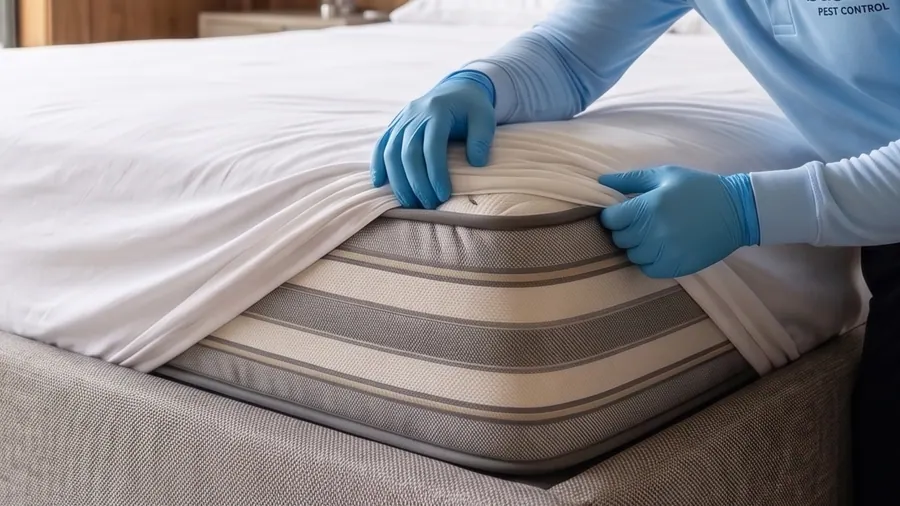
- The mattress piping, all four sides, plus the tag and the handles.
- The box spring, which is better habitat than the mattress. Lift it and check the underside, including the stapled gauze.
- The bed frame joints, especially where two pieces bolt together, and every screw hole.
- The headboard, including the back and the wall behind it. This is the one most people never take off the wall.
- The nightstand, drawers out, turned over.
- Upholstered furniture where somebody regularly sleeps or naps. A recliner in a living room counts, and gets missed.
Two rules make the difference. Use a real flashlight, not a phone torch held straight on. And check the box spring properly, because on a lot of jobs it holds more than the mattress does.
When it is not a bug at all
Sometimes there is nothing to find, and that is a real answer rather than a failed inspection.
Texas A&M AgriLife publishes a guide for exactly this situation, Diagnosing Mysterious Bug Bites, and its list of non-insect causes is longer than most people expect. Enzyme-based detergents, fabric softeners, soaps, creams, makeup, deodorants and perfumes all show up on it. So do mold spores from houseplants and humidifiers, static electricity, and several medical conditions.
Its core instruction is the one we would give you too: it is essential to diagnose the cause of a problem before prescribing a treatment. Practically, that means catching a specimen. Tape or sticky traps along the edges of walls and under and around the bed work well. A&M also notes that vacuum bag contents are seldom helpful, which is worth knowing before you go to the trouble.
Do not start treating on bites alone
- Bites are not diagnostic. Reactions vary so much between people that two adults in the same bed can show completely different marks, or none.
- Bug bombs make bed bugs worse. They scatter the population deeper into walls and into neighboring rooms. Foggers are the most common reason a small problem becomes a whole-house one.
- Throwing out the mattress rarely ends it, and it moves the problem into the hallway on the way out.
- Get a specimen first. One bug in a zip bag or one sharp photo settles in a minute what a week of guessing will not.
This page is general information, not medical advice. If a bite reaction worries you, call your doctor. Bastion Pest Control assumes no liability for injury or illness resulting from information on this page.
If you want a free second opinion that has nothing to sell you, Travis County has an AgriLife Extension IPM program staffed by an entomologist who will identify what you found.
Send us the photo before you book anything.
Take one sharp close-up, on a plain background, with something for scale next to it. A coin works. We will tell you what it is, and if it turns out to be a carpet beetle we will say so and you will not hear from us again.
Common questions
Can you see bed bugs with the naked eye?
Adults yes, easily. They are 5 to 7 mm, about an apple seed, and plainly visible on a white sheet. The first three nymph stages are a different matter. At 1.5 to 2.5 mm and close to transparent, the EPA describes them as nearly invisible to the naked eye, which is why a clean self-inspection is not proof of anything.
What is the difference between a bed bug and a bat bug?
The fringe of hairs just behind the head. On a bat bug those hairs are longer than the eye is wide. On a bed bug they are shorter. Colorado State University says the call needs a hand lens or a microscope, so nobody is reading it across a bedroom. The difference matters because bat bugs come from a roost, usually in an attic, and treating the bed will not touch the source.
Does finding bed bugs mean my house is dirty?
No, and this one is worth saying plainly. Bed bugs feed on blood, not crumbs, so there is nothing in a clean house that makes it less appealing to them. They arrive on luggage, on secondhand furniture, in a moving box, or through a shared wall. Clutter gives them more places to hide, which is a real problem, but it is not what brought them in.
Do bed bugs fly or jump?
Neither. They have no working wings, only small pads behind the head, and the University of Kentucky states directly that they do not fly or jump like fleas. They crawl, and they crawl fast, across floors, up walls and along ceilings. If the thing you are looking at jumped, it was almost certainly a flea.
Sources
- US Environmental Protection Agency, Bed Bugs Appearance and Life Cycle
- US Environmental Protection Agency, How to Find Bed Bugs
- US Environmental Protection Agency, Top Ten Tips to Prevent or Control Bed Bugs
- Texas A&M University, Urban and Structural Entomology Program, Bed Bugs
- Texas A&M AgriLife, Insects in the City, Bed bugs
- Texas A&M AgriLife, Diagnosing Mysterious Bug Bites
- University of Kentucky Entomology, Bed Bugs, ENTFACT-636
- Colorado State University Agricultural Biology, Bed Bug Look-Alikes
- University of California Statewide IPM Program, Carpet Beetles
- Texas A&M University, Urban and Structural Entomology Program, German Cockroach
- AgriLife Extension, Travis County IPM
Answered 24 hours · Austin, TX
Not sure what you found? Send us a photo.
One close-up with a coin next to it is usually all it takes. We will tell you what it is, whether it needs treating, and what a bed bug job on your place would involve. If it turns out to be a carpet beetle, we will tell you that instead.