Roof rats in Texas
Roof rats in Central Texas are in the attic, not the kitchen
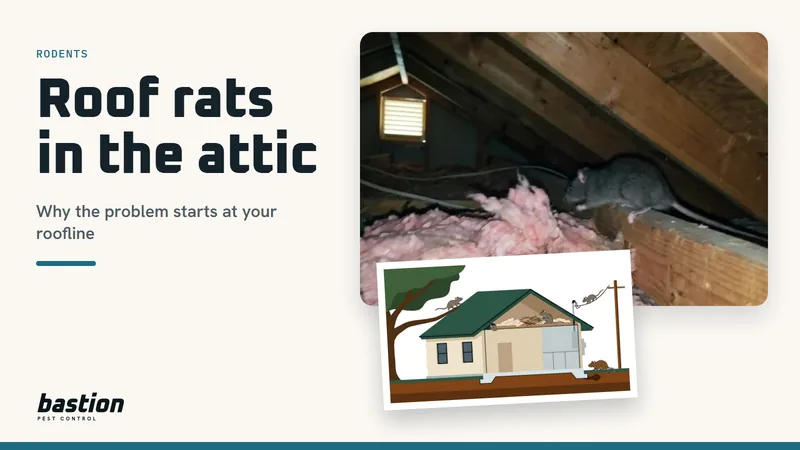
Roof rats (Rattus rattus) are the slender, dark, long-tailed rats of Central Texas that live above you. They climb in from trees, fences and utility lines and nest in attics and walls, so a rat heard overhead is usually a roof rat, while a burrow at the slab points to a Norway rat.
The short answer
- Also called
- Black rat, house rat, ship rat
- Tail
- Usually longer than head and body
- Nests
- Attics, wall and ceiling voids
- Gets in from
- Tree limbs, fence tops, power lines
Roof rats are the most common rat in Texas homes, according to Texas A&M AgriLife. The fix that lasts is sealing the gaps, which UC IPM calls the most successful and longest-lasting rat control around a building.
Prefer to listen? One minute 21.
The short version, read aloud. Read by a synthetic voice, not one of our technicians.
What a roof rat is, and why it lives above you
Roof rats (Rattus rattus) are the slender, dark, long-tailed rats of Central Texas that live above you. They climb in from overhanging trees and power lines and nest in attics and walls.
The black rat is by far more common in the southern United States than the Norway rat and in Texas usually frequents attics, rafters and crossbeams.
Roof rat vs Norway rat: the side-by-side
A roof rat is the sleeker climber that nests high, and a Norway rat is the heavier burrower that lives low. The roof rat vs Norway rat question matters because the two get in, and get fixed, in different places.
| Trait | Roof rat | Norway rat |
|---|---|---|
| Adult weight in Texas | Up to 200 g | 400 to 500 g |
| Tail against body | Usually longer than head and body | Shorter than head and body |
| Ears folded forward (UC IPM) | Reach the eyes | Do not reach the eyes |
| Muzzle and build | Pointed muzzle, sleeker | Blunt muzzle, heavier |
| Droppings (Internet Center for Wildlife Damage Management, ICWDM) | About 1/2 inch, pointed ends | Up to 3/4 inch, blunt ends |
| Where it lives in a house | Attics, rafters, wall and ceiling voids | Basements and the ground floor |
The clip below shows how differently the two rats live.
Other types of rats in Texas
The types of rats in Texas run well past these two, though none of the three natives below is an attic animal in these accounts. The hispid cotton rat normally lives in tall grass, and the eastern and southern plains woodrats build stick piles called middens, and the eastern woodrat may build them in barns and other outbuildings.
Six Texas rodents, nose to tail tip
Average total length, and how much of it is tail. Millimeters, with inches.
- Total length
- Tail length, and its share of the total
Rat or squirrel? Signs of rats in the attic
Night noise points to a roof rat, but droppings confirm it. Texas A&M AgriLife says noises in the attic or ceiling, especially at night, can indicate roof rats, yet an AgriLife Extension author's own ceiling footsteps turned out to be a squirrel.
- When you hear it. Night activity fits a roof rat. UC IPM says they are often seen at night running along overhead utility lines or fence tops.
- What is on the attic boards. Check the droppings' length and ends against the table's two rats.
- Where you saw it. A rat on a fence top or a wire at night points up.
- What else it could be. A squirrel is the classic false alarm, as the AgriLife story shows.
How roof rats get from a live oak into your attic
How do roof rats get in the attic? Usually from above: off a tree limb or power line, then through a roof or soffit gap.
- The soffit and eaves. CDC's sealing checklist for the roof covers the rafters, gables, eaves and soffits.
- Roof vents and flashing. Texas A&M lists venting and flashing on the roof among the likeliest entry points for most homes.
UC IPM says to seal all holes larger than 1/4 inch, and to use metal, because rats can chew through plastic, foam, wood and caulk. It is the same logic we use to keep scorpions out of Austin homes.
Are roof rats dangerous in Travis County?
They can be, through disease and damage. CDC says rodents spread disease directly through handling, contact with droppings, urine or saliva, and bites, including leptospirosis, rat-bite fever and salmonellosis.
For flea-borne typhus, the Texas Department of State Health Services (DSHS) names rats and their fleas as the natural reservoirs, adds that opossums and domestic cats may also transmit it, and lists Travis County among the new areas where the disease is now endemic.
Flea-borne typhus in Travis and Williamson counties
Reported cases per year, 2008 to 2025. Travis 453 in total, Williamson 55.
- Travis County
- Williamson County
DSHS says to treat for fleas before rodent control, because when the rodents die, their fleas search for new hosts. If a pet or the yard has fleas, flea control goes first.
The other risk is the house: rats in attics may chew on wiring, with the potential to start a fire.
Traps, bait and sealing, in the order that works
Treat fleas, seal, then trap, and save bait for rats that persist. Waiting fails because roof rats in Texas breed all year, and traps or bait alone leave the way in open.
- Fleas first. Treat for fleas before any rodent control, per DSHS.
- Seal the entry points. Texas A&M's first step is to inspect and seal the likeliest ones.
- Trap where the droppings are. UC IPM calls snap traps the safest, most effective and most economical way to trap rats.
- Bait only if it persists. CDC reserves poison and bait stations for infestations that persist, and Texas A&M says bait leads to dead-animal smells.
- Skip glue boards, live traps and ultrasonics. CDC says the first two scare rodents into urinating, which can raise your chance of getting sick, and ICWDM says ultrasonic devices "have not been proven to provide rat control."
A homeowner can prune limbs, seal a gap at a meter or garage door, and set snap traps. It outgrows DIY when the gaps are at the roofline, the way in cannot be found, or the traps keep filling.
What a roof rat job with us covers
Our rodent control covers the whole house: a full inspection from the roofline down, every entry point found, and the rats inside removed. An active infestation is a separate job from $449, and physical exclusion, the sealing itself, is quoted on top after the inspection. The General Pest + Rodent plan from $66 a month keeps watch after that. Both are starting prices; your exact number depends on home size, lot size and current pest pressure. See pricing or rodent control in Austin.
Clean up last, and never sweep dry droppings
- No broom, no vacuum. CDC says sweeping or vacuuming can put tiny droplets containing viruses into the air.
- Soak it. Air it out for 30 minutes first. Then, in rubber or plastic gloves, spray droppings and urine with bleach solution (1.5 cups of household bleach in 1 gallon of water) or an EPA-registered disinfectant until very wet, then wait 5 minutes or as the label says.
This is general information, not medical advice. If you feel ill after contact with rodents, see your doctor.
Common questions
Do roof rats come down into the kitchen?
A rat in the pantry usually started somewhere else: UC IPM says roof rats routinely travel up to 300 feet or more for food, and the ICWDM handbook gives 100 to 300 feet. A nest in the attic sits well within that range of the kitchen.
When are roof rats worst in Austin?
There is no off season. Mammals of Texas says black rats in Texas breed all year, with peaks in February and March and again in May and June. For other pests, see the Austin pest calendar.
Do roof rats carry hantavirus?
CDC says the most common US hantavirus behind hantavirus pulmonary syndrome is spread by the deer mouse, and its overview does not name roof rats. Mammals of Texas adds that the native hispid cotton rat has been implicated as a possible reservoir for Black Creek Canal virus, another cause of the syndrome.
Is my Austin landlord responsible for rats in the ceiling?
Austin city code requires landlords to maintain rentals free from rodent or insect infestations, and rat problems can be reported to Austin 3-1-1. Tell the landlord where and when you hear it, with a photo of the droppings, and if a visit only sets traps, ask about the entry points.
Hearing it over the ceiling tonight?
Call and tell us where you hear it and when. We will tell you whether it sounds like a roof rat, a Norway rat or a squirrel, and whether you need us at all.
Call 843-480-8699 Phone answered 24/7. Same-day service most days.Sources
- Texas A&M AgriLife Extension, Insects in the City, Biting Mites (ENT-3009)
- University of California Statewide IPM Program, Pest Notes: Rats
- Texas A&M AgriLife Extension, School IPM, IPM Action Plan for Rodents
- Texas Tech University Natural Science Research Laboratory, The Mammals of Texas, Black Rat
- Texas Tech University Natural Science Research Laboratory, The Mammals of Texas, Norway Rat
- Texas Tech University Natural Science Research Laboratory, The Mammals of Texas, House Mouse
- Internet Center for Wildlife Damage Management, Roof Rats
- Internet Center for Wildlife Damage Management, Norway Rats
- Texas Tech University Natural Science Research Laboratory, The Mammals of Texas, Southern Plains Woodrat
- Texas Tech University Natural Science Research Laboratory, The Mammals of Texas, Hispid Cotton Rat
- Texas Tech University Natural Science Research Laboratory, The Mammals of Texas, Eastern Woodrat
- Texas A&M AgriLife Extension, Insects in the City, Rodents in attics
- Centers for Disease Control and Prevention, Healthy Pets Healthy People, Seal Up
- Internet Center for Wildlife Damage Management, Roof Rat Biology
- Centers for Disease Control and Prevention, Healthy Pets Healthy People, Rodent Control
- Texas Department of State Health Services, Zoonosis Control, Flea-borne Typhus
- Texas Department of State Health Services, Flea-borne (Murine) Typhus
- Texas Department of State Health Services, Flea-borne Typhus Cases by County, 2008-2025 (PDF)
- Centers for Disease Control and Prevention, About Hantavirus
- Centers for Disease Control and Prevention, Healthy Pets Healthy People, Trap Up
- Internet Center for Wildlife Damage Management, Roof Rat Prevention and Control Methods
- Centers for Disease Control and Prevention, Healthy Pets Healthy People, Clean Up
- City of Austin, Report Problems with Rodents
Answered 24 hours · Austin, TX
Hearing something in the attic at night?
Call or text 843-480-8699 and tell us what you heard, where, and what time of night. A description is often enough to tell a roof rat from a squirrel, and to tell you which job it is before anyone climbs a ladder.