Scorpions
Are there scorpions in Austin?
Yes. Texas A&M has recorded two scorpion species near Austin, and finding one indoors is normal here rather than alarming. Which one you are looking at, when they show up, and when it is actually worth doing something.
The short answer
- Species recorded near Austin
- Two
- The one you will meet
- Striped bark
- Peak months
- June to August
- Active
- After dark
- Sting
- Painful, not lethal
- Nests or colonies
- None
Yes, Austin has scorpions, and almost every one you find will be a striped bark scorpion. They come in through weep holes, garage door corners and door sweeps, mostly between April and October and mostly at night. A sting hurts, but Texas has no scorpion considered lethal to people. One scorpion is not an infestation. A pattern of them is, and the difference is the whole point of this page.
Prefer to listen? One minute 27.
The short version, read aloud. Read by a synthetic voice, not one of our technicians.
It is usually eleven at night. You get up for water, hit the kitchen light, and something flat and pale is sitting on the tile with its tail curled over its back. It does not run. It just waits there while you decide what you are.
That is the moment most people search for this. So, plainly: yes, Austin has scorpions, and no, it does not mean anything is wrong with your house.
Yes: the two scorpion species found near Austin, Texas
Texas has around 18 scorpion species, and most of them live out in the arid west of the state. Only one, the striped bark scorpion, is found right across Texas. Austin sits at the quiet end of the range.
Texas A&M AgriLife Extension counted the species recorded around different Texas towns, and the gap is bigger than most people expect.
Scorpion species recorded near Texas towns
Austin is not scorpion country. West Texas is.
| Species | What it looks like | Where it lives | Seen indoors? |
|---|---|---|---|
| Striped bark scorpion Centruroides vittatus | Slender, yellowish to tan, with two broad dark stripes down the back. About 2 and 3/8 inches long. | Under rocks, boards and debris. Rocky slopes, juniper breaks, mulch beds, wood piles. | Yes, almost always this one |
| Texas cave scorpion Pseudouroctonus reddelli | Stocky and dark, close to black, with heavier pincers. | The limestone karst of the Balcones Escarpment. Caves, grottos, rock walls. | Rarely |
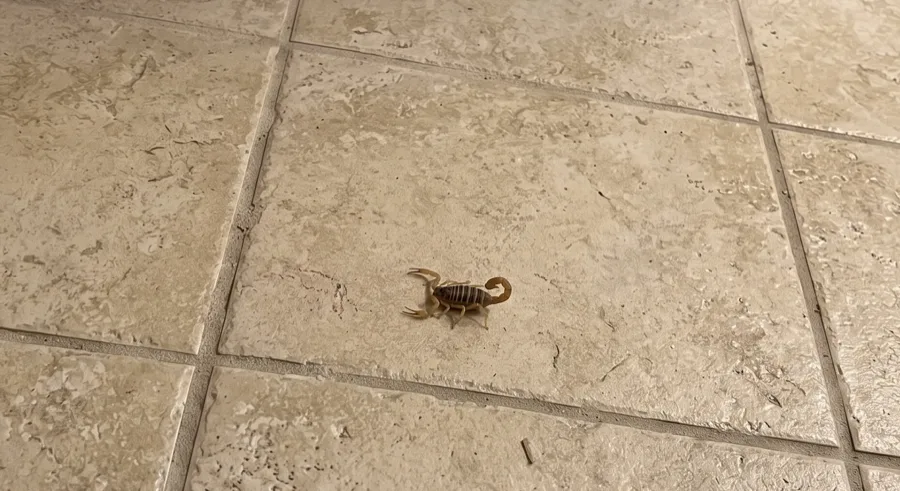
The striped bark scorpion is the one on your tile. Description and measurements come from the Field Guide to Common Texas Insects. If you want to be certain what you have at midnight, a cheap blacklight settles it: A&M notes that for reasons still unknown, the scorpion cuticle fluoresces under ultraviolet light. They glow a pale green. Nothing else in your kitchen does.
How bad is a scorpion sting, honestly
It hurts, roughly like a wasp, and then it goes away. No Texas scorpion is considered lethal to people.
Texas A&M puts it this way: stings from Texas scorpions produce only moderate reactions in most people, because the venom has little effect on the nervous system. The Field Guide describes what you actually feel as swelling, discoloration, numbness and pain, lasting anywhere from several minutes to several days. On our own Austin scorpion page we describe it as comparable to a wasp, fading within a day or two, and that matches what most people report. Some people stay sore longer.
The practical advice from Travis County's own extension entomologist is unglamorous and it works.
"Usually it's sufficient to apply ice packs on the area where the sting occurred to reduce pain and swelling."
Wizzie Brown, AgriLife Extension entomologist for Travis County, Texas A&M AgriLifeWhen a sting does need a doctor
- The person stung is a small child or an elderly adult.
- Anyone with a known sting allergy, or a history of a bad reaction to bees or wasps.
- Trouble breathing, swallowing or speaking, swelling away from the sting site, a racing heart, or muscle twitching.
- Pain and swelling that are getting worse after 24 hours rather than better.
This page is general information, not medical advice. If you are worried about a sting, call your doctor or Poison Control. Bastion Pest Control assumes no liability for injury or illness resulting from information on this page.
When scorpions show up in Austin
Late spring through September, peaking in the summer heat, and almost entirely after dark. Barely anything in February. Everywhere by July.
They are not coming in for the air conditioning. In a hot dry stretch they are hunting water, which is exactly why so many sightings happen in bathrooms and kitchen sinks. Wizzie Brown describes the behavior as a way to manage temperature and water balance, which matter a great deal to an animal built for dry habitat.
Two weather patterns reliably produce a call. A long dry spell drives them in looking for moisture. A heavy storm floods the ground harborage they were sheltering in and pushes them up and out. Sightings often spike a day or two after a big Austin rain.
How scorpions get into the house
Weep holes, garage door corners, worn door sweeps and slab expansion joints. Not holes they made. Gaps that were already there.
A striped bark scorpion is flat. A weep hole in a brick wall is a wide open door to something that shape, and a gap the thickness of a credit card under a garage door is enough. They also climb well: A&M notes it is common for this species to climb trees and walls, and that many home reports come from attics. On an older pier-and-beam house in Hyde Park or Travis Heights, a wall void runs unbroken from crawlspace dirt to ceiling, which is how one gets into an upstairs bathroom without ever crossing a floor.
| Way in | Why it works for them | The fix |
|---|---|---|
| Weep holes | Open by design, to drain the brick cavity | Copper mesh or stainless weep guards. Do not caulk them shut. |
| Garage door corners | The seal never quite meets the slab at the ends | New bottom seal, plus corner pads |
| Door sweeps | Worn rubber leaves a card-width gap | Replace the sweep, add a threshold seal |
| Slab cracks and expansion joints | Clay soil shrinks in summer and opens them up | Backer rod and flexible sealant |
| Pipe and line-set penetrations | Drilled oversize, rarely sealed after | Foam and sealant, or mesh for larger gaps |
| Firewood and stone stacked on the house | Perfect daytime harborage, right against the wall | Move it 20 feet out and up off the ground |
When one scorpion is just one scorpion
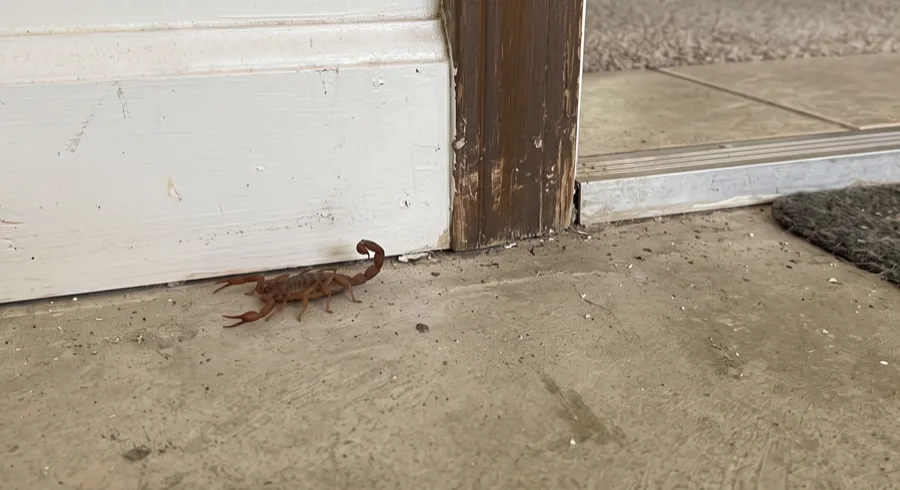
One scorpion in the garage in July is a wanderer, not an infestation. You do not need to call anybody.
Scorpions are not social. They do not build a nest, they do not run a colony, and there is no queen sitting in your wall producing more of them. The one you found came in on its own, from the soil, the rock or the mulch outside. That is worth saying out loud, because almost every page selling scorpion control quietly implies otherwise.
A&M's own extension advice on scorpions found outdoors is to leave them alone, since they are useful predators, and to scoop an indoor one back outside rather than kill it. A wide jar and a piece of card is the whole method.
Before you spend money, do the free work. It outperforms spraying, and it is the same list our technicians work through anyway:
- Replace the door sweeps. Front, back, and the door from the garage into the house. Roughly $15 each and it closes the most common way in.
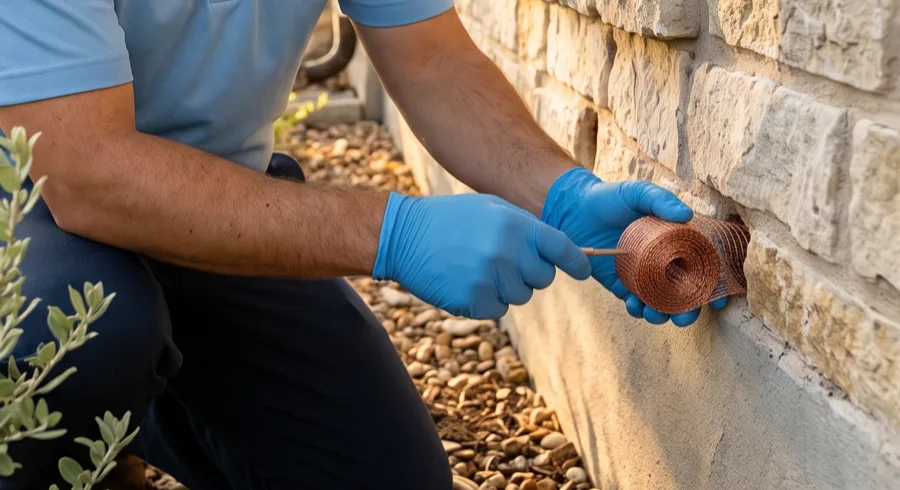
- Screen the weep holes. Copper mesh, pushed in, not caulk. The holes need to keep draining.
- Move the woodpile. Twenty feet from the wall and off the ground, per AgriLife's exclusion advice. Firewood stacked against a house is the single best scorpion habitat you can build.
- Cut back what touches the wall. Branches and shrubs against the siding are a ramp.
- Pull mulch and rock back from the foundation. Six inches of bare soil removes the daytime hiding place right where they would enter.
- Wear gloves in the yard. Leather ones, when you are moving rock, wood or pots. Most stings happen to a hand that reached under something.
If you want a second opinion that costs nothing at all, Travis County has an AgriLife Extension IPM program staffed by an entomologist who will help you identify what you found, for free.
When it is worth calling someone
Repeat sightings, bedrooms, or someone in the house with a sting allergy. Those three change the answer.
The honest line is about pattern, not count. Three indoors in a week is a pattern. One in a bedroom is a pattern of a different kind, because that is where a bare foot meets one at 2am. If you have done the sweeps and the weep holes and they are still turning up, the harborage is close enough to the house that exclusion alone will not hold it.
That work is mostly sealing and void treatment rather than spraying open floors. A scorpion has a waxy cuticle and walks on its leg tips, so it contacts very little product crossing a treated surface. Treating where they sit all day and closing the ways in is what actually holds.
Not sure whether yours is a pattern?
Tell us how many you have seen, where, and over how long. If it sounds like a wanderer we will say so and tell you which sweep to replace. That conversation is free and it does not end with a quote unless you ask for one.
Common questions
Are scorpions in Austin poisonous?
Venomous, not poisonous, and the distinction is not pedantry. Poison is something you eat. Venom is injected, and a striped bark scorpion injects a small amount that Texas A&M describes as having little effect on the nervous system. No scorpion in Texas is considered lethal to people.
What kills scorpions on contact?
Very little, and that is the honest answer. Their waxy outer layer and the way they walk on their leg tips means they pick up almost nothing from a sprayed surface. Sealing the gaps and treating the voids where they shelter does far more than any spray you can buy, which is why our own scorpion work is mostly exclusion.
Do scorpions come in nests or pairs?
No. They are solitary hunters with no colony and no queen. A female carries her young on her back for their first week or so, which is the closest thing to a group you will see, and it happens outdoors under a rock, not in your wall. Finding one does not mean there are fifty behind the drywall.
Why do I only see them at night?
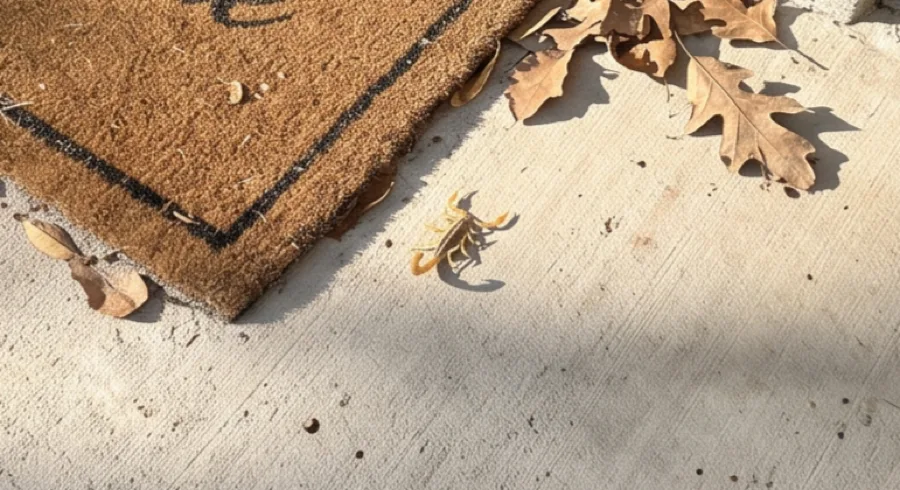
They hunt after dark and spend the day pressed into something tight. If you want to know what is actually in your yard, walk it after dark with a blacklight. Texas A&M notes the scorpion cuticle fluoresces under ultraviolet light, so they light up pale green against the rock. It is a genuinely unsettling first experience and a very useful one.
Sources
- Texas A&M AgriLife Extension, Scorpions: Identification, Habitat and Control in Texas
- Field Guide to Common Texas Insects, striped bark scorpion
- Insects in the City, Texas A&M AgriLife, striped bark scorpion
- Texas A&M AgriLife Urban IPM, striped bark scorpions
- AgriLife Today, hot dry summer has scorpions heading indoors
- AgriLife Extension, Travis County IPM
- UT Bureau of Economic Geology, Central Texas
Answered 24 hours · Austin, TX
Seen more than one? Let's talk about it.
Tell us how many, where in the house, and over how long. We will tell you whether it is a wanderer or a pattern, which gaps to close first, and what a scorpion service on your house would actually cost. If you do not need us, we will say that instead.