Austin, TX and 25 more cities
Mole control
Bait placed underground, right inside the tunnels they actually use.
Quick answers
Mole control in Central Texas: the quick facts
Mole damage shows up in spring and fall, when damp soil brings worms up and the mole works shallow. Mole control is $333 per stop with a three-stop minimum, so $999 for a lot up to half an acre, thirty days between stops. A fourth stop, if it is needed, is free.
- Peak windows
- Spring & fall
- Damp soil brings worms up, so the mole works shallow and you get ridges.
- Price
- $333 per stop
- Three-stop minimum, so $999 up to half an acre. Each extra half acre adds $30 a stop.
- Fourth stop
- Free
- If three stops have not settled it, the fourth one costs you nothing.
- Best time to act
- Early spring
- Texas A&M advises going after them at the first signs of spring activity.
Written by the Bastion Pest Control service team · Licensed & insured in Texas · Last updated
Moles in Central Texas.
Moles are not after your plants. They are hunting grubs and earthworms, and a well-watered Central Texas lawn is a buffet of both. Texas A&M AgriLife makes the same point: the tunnelling is a search for food, and the plant damage is a side effect of it. Which is the cruel joke: the healthier your yard, the more it takes the worst damage.
Surface traps and repellents mostly miss, because moles live their entire lives underground and are not coming up to read your reviews. The reliable fix is finding the active runs and treating inside them.

Seasonal pattern
When mole damage shows up in Central Texas.
Here is the thing about moles: the animal never leaves. It does not hibernate and it does not migrate. What changes through the year is how close to the surface it has to work, and that is entirely down to how damp the soil is. So this chart tracks the evidence you can actually see, the ridges and the mounds, rather than how many moles you have.
- Peak windows
- Spring & fall
- Damp soil brings the worms up, so the mole works shallow and you get ridges. The March litter adds to the spring surge.
- The summer lull
- July & August
- Baked ground pushes the whole operation deeper. The ridges stop appearing, which is not at all the same thing as the mole leaving.
- Best time to act
- Early spring
- Texas A&M advises going after them at the first signs of spring activity, before one run turns into a whole network.
Warning signs
Read the lawn, not the mole.
Raised ridges winding across the lawn
Cone-shaped mounds of loose soil
Tunnels that stop dead at a patio or sidewalk edge
Fresh soil pushed up after a rain
Moles are rarely a same-day emergency, but timing matters, because one run becomes a network fast and damp soil is when active tunnels are easiest to find. Text a photo of the ridges to 843-480-8699. We can usually confirm mole versus gopher from the picture and tell you whether it needs attention this week. Not sure it is a mole at all? Our guide to telling mole, gopher and grub damage apart reads the pile, the hole and the ridges.
How we get rid of moles.
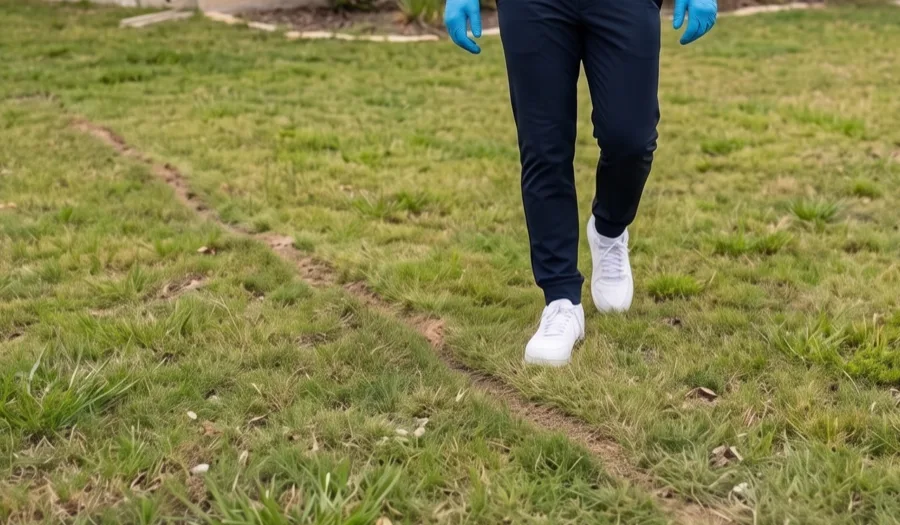
Inspect
We locate the active runs, not the abandoned ones.
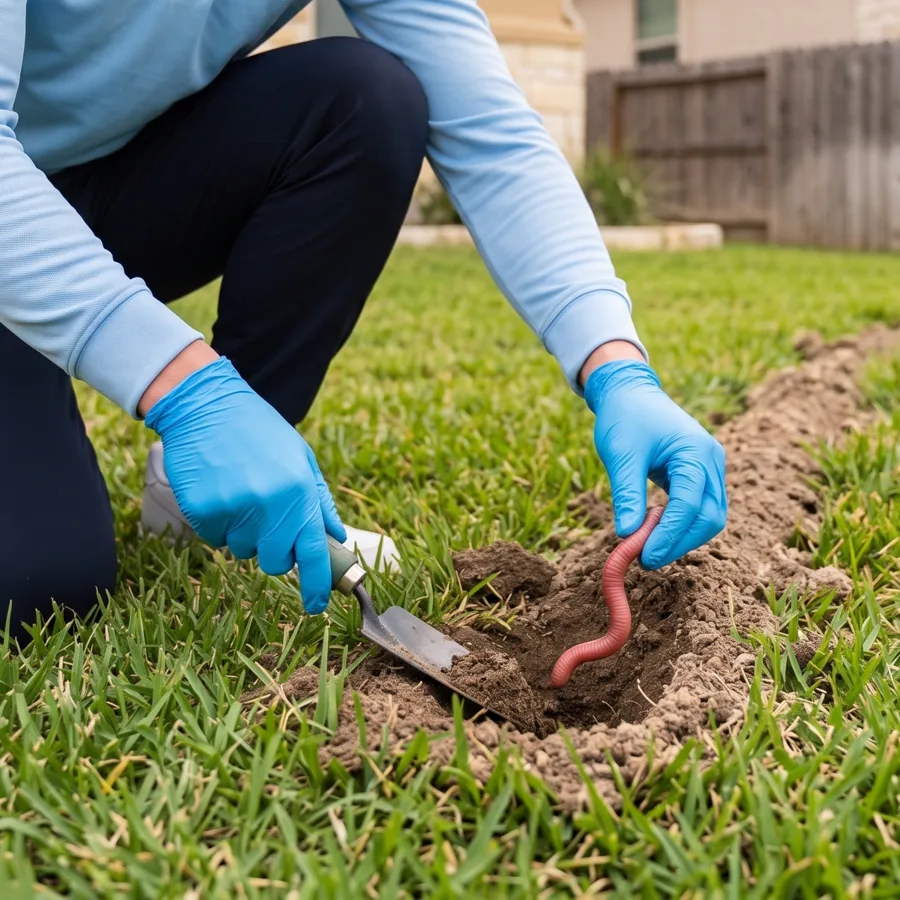
Treat
Bait placed directly inside the tunnels, below ground.
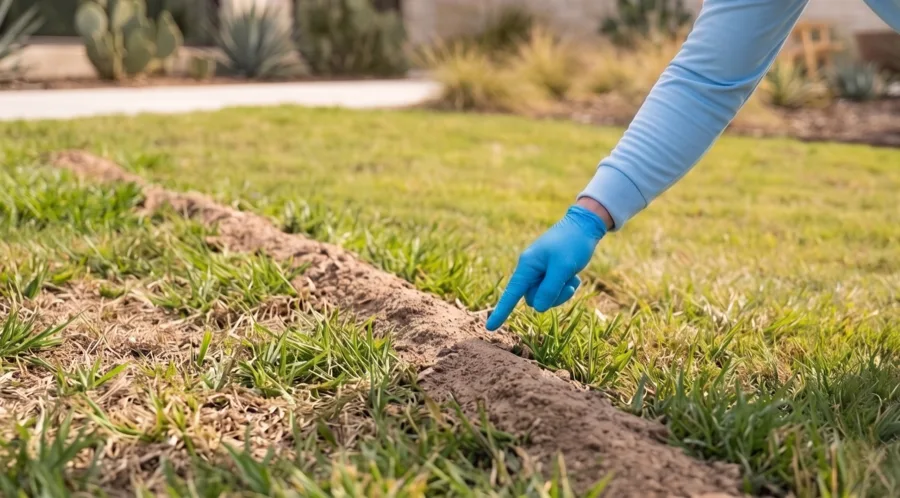
Protect
We re-check the runs and re-treat until they go quiet.
What mole damage actually looks like.
Every photo here came off a real Central Texas yard. You almost never see the mole itself, so this is what we actually look for: mounds, ridges, and the point where a run meets a hard edge.
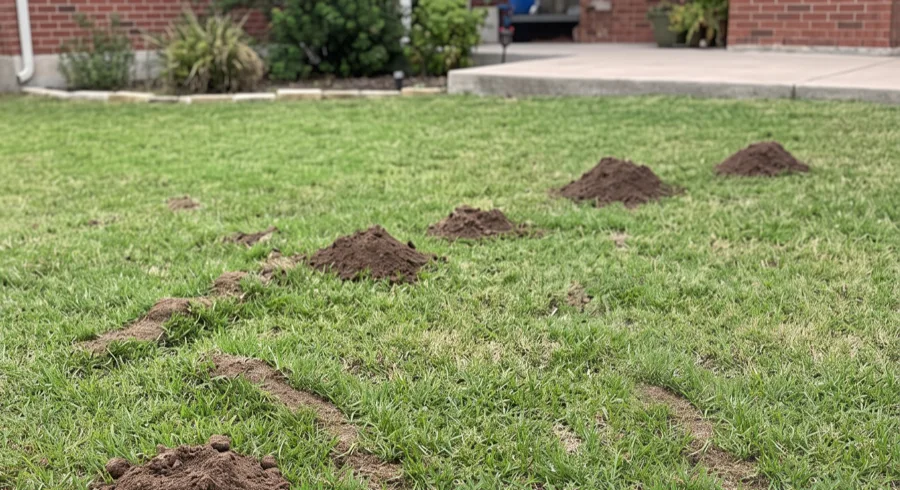
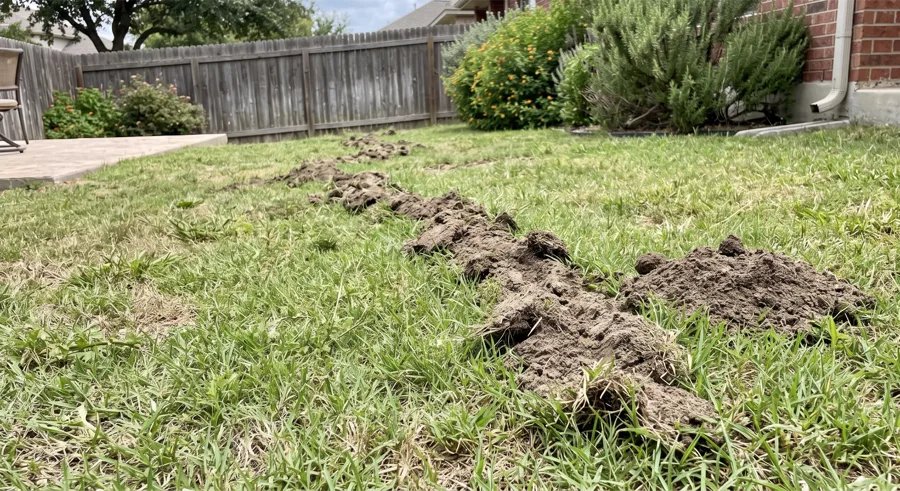
Five or six mounds in a line, biggest to smallest. That progression is the colony working outward from wherever it started.
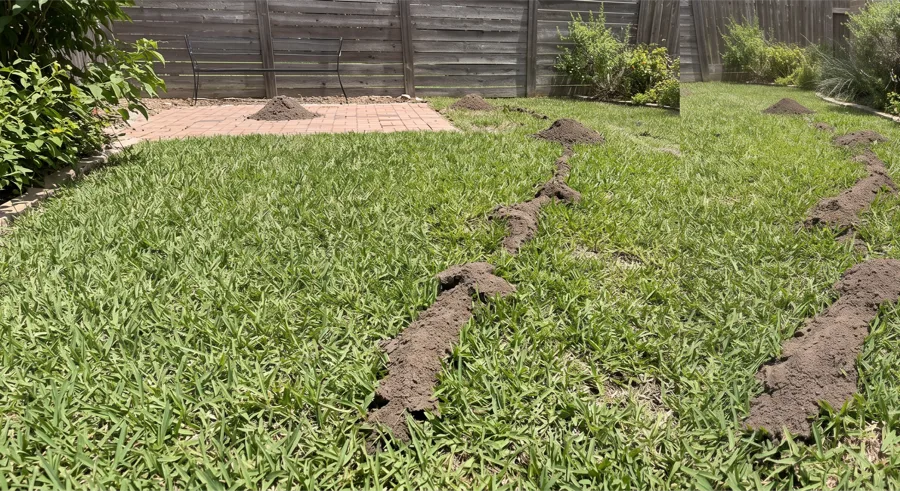
The raised ridge runs straight up to the paver edge and stops, because the paving is where the tunnel had to surface.
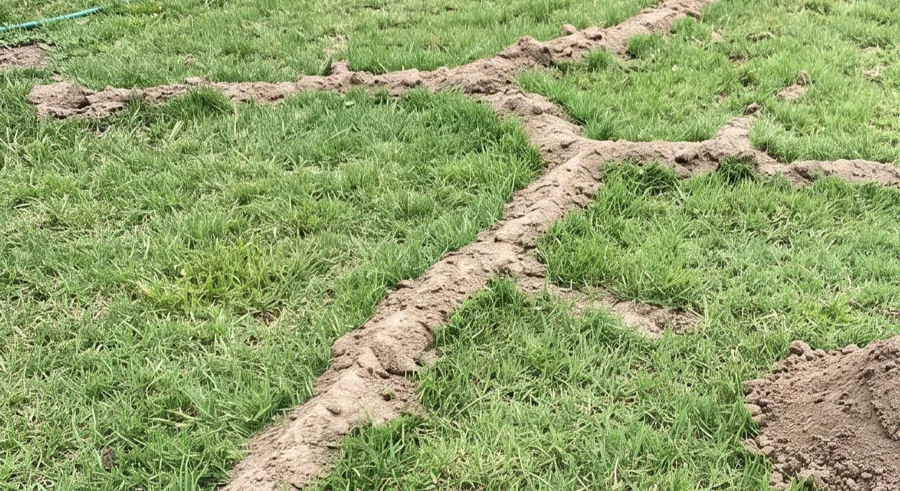
Two runs crossing rather than one straight tunnel. Once you see a junction like this, you are looking at a network, not a single visitor.
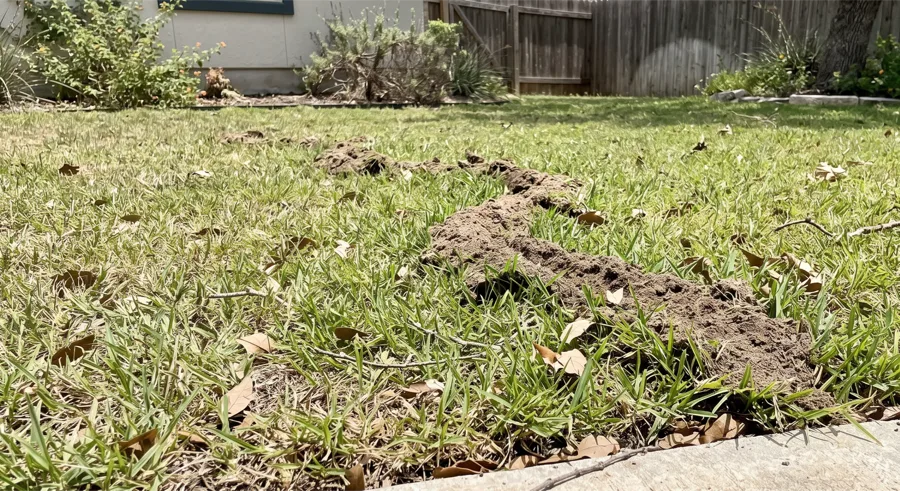
Tunnelling right along the hard edge of the concrete. Moles follow edges and borders because the soil there is easier to read for prey.
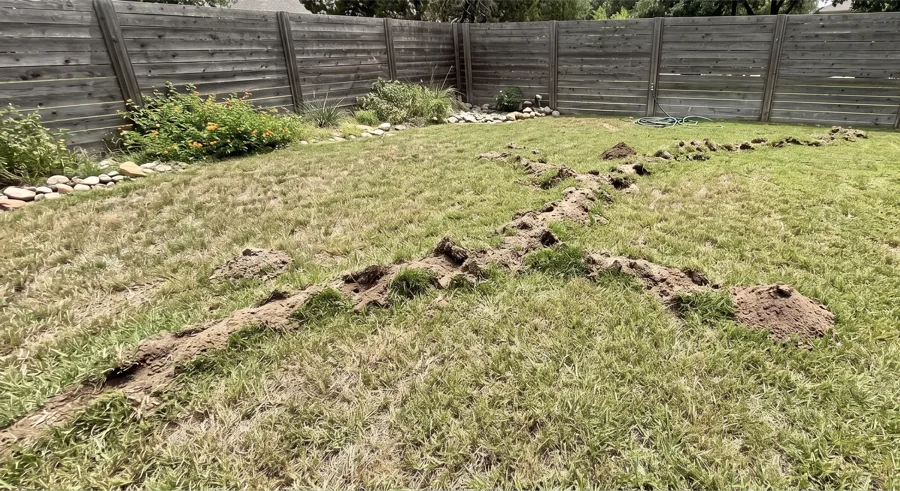
Starts as a faint line near the hose reel and finishes as an obvious ridge by the rock border. Early damage and established damage side by side.
Tracking the flower bed at the foundation before finishing in a fresh mound. Beds like this hold moisture, which is exactly what keeps the tunnelling close to the house.
Photographs by the Bastion Pest Control service team. Not sure if what you are looking at is mole activity or something else? Text a photo to 843-480-8699 and we will tell you.
Pest-Free Guarantee
They come back? So do we, free.
Free re-treatments between scheduled visits on any recurring plan.
Mole control is a set job, not a monthly plan.
Moles are not part of the recurring pest plan, because getting rid of them is a different kind of work. It is $333 a stop with a three stop minimum, and that minimum is not padding. Three passes across two months is the only way we can actually stand behind the result, so it is the only way we will sell it.
Mole control
$999*total
*Three stops at $333 each, thirty days apart, for a lot up to half an acre. Every additional half acre adds $30 per stop.
| Visit | When | What happens |
|---|---|---|
| Visit one | Day one | We find the active runs and leave the abandoned ones alone, then bait directly inside the tunnels, below ground. |
| Visit two | Thirty days later | We re-check every run. Anything still showing activity gets treated again. |
| Visit three | Sixty days later | Final pass over the yard, any fresh runs treated, and we confirm the tunnelling has actually gone quiet. |
Re-treating a run that is still active is part of the three stops, not an extra line on the bill. And if the yard is still not quiet when those three are done, the fourth stop is free. That is the guarantee, and the three stop minimum is exactly what lets us offer it.
* Starting price. Your exact number depends on home size, lot size and current pest pressure.
Mole control, answered straight.
Do I have moles or gophers?
The raised ridges are the giveaway. Moles push up surface runways you can trace across the lawn with your foot, and gophers do not do that. What a gopher leaves instead is a horseshoe or fan shaped mound, roughly 8 to 24 inches across and about 6 inches high, with the hole plugged off to one side. Texas A&M AgriLife warns specifically that the two get confused. Both animals turn up around the Austin metro, they are not the same job, and treating for the wrong one wastes your money. Send us a photo and we will tell you which you are dealing with.
What attracts moles to a Central Texas yard?
Food and soft soil, in that order. Moles eat earthworms, grubs, beetles and insect larvae, and Texas A&M AgriLife puts their daily intake at 70 to 100 percent of their own body weight. That is a relentless appetite, and it needs a yard that can supply it. A well-watered lawn holds moisture, moisture keeps worms near the surface, and that is exactly the combination a mole is hunting for. Which is the irritating part: the better you look after your lawn, the more appealing it becomes.
Do moles eat my grass and plant roots?
Mostly no. Texas A&M AgriLife lists the mole diet as earthworms, grubs, beetles and insect larvae, with vegetation making up only a small portion of it. The damage you are looking at is mechanical rather than grazing. Roots get lifted and dislodged as the animal tunnels underneath, and the grass sitting directly over a run dries out and browns off. That is why reseeding on its own does not fix anything. The tunnelling has to stop first.
Do mothballs, castor oil or ultrasonic repellers get rid of moles?
We would not rely on any of them. A mole lives its entire life inside a tunnel network it can reroute at will, so the usual response to something unpleasant in one run is a fresh run a few feet away, not a mole leaving your property. Mothballs are also not a labeled product for moles, and we are not going to recommend using a pesticide outside its label. Texas A&M AgriLife guidance for moles centers on working the active runs directly, which is the approach we take.
When is the best time to treat for moles?
Early spring, if you get the choice. Texas A&M AgriLife recommends going after them at the first signs of spring activity, before one run turns into a whole network. The timing suits the biology too: damp spring soil keeps moles working close to the surface where the active runs are easy to find, and their single litter of the year arrives March to early April. The summer lull is the worst time to judge a yard, because hard dry ground hides activity that has not actually stopped.
How much does mole control cost in Austin?
Mole control is $333 a stop with a three stop minimum, so $999 for a lot up to half an acre, with thirty days between stops. Every additional half acre adds $30 per stop. If the yard still is not quiet once those three are done, the fourth stop is free. Moles are not part of the recurring monthly pest plan, because clearing them is a different kind of work with its own timeline.
More questions? Read the full FAQ or get a free quote.
Other pests we treat
One recurring plan covers all of these. No per-pest pricing and no upcharge when a different one shows up.
Every plan includes the full TriBarrier™ treatment. See all services →
Answered 24 hours · Austin, TX
Ready to be done with it?
Quotes are free, there is no inspection fee, and the phone is answered around the clock. Same-day service is usually open across the metro.