Rodents in Central Texas
Norway rats in Austin, the rat that digs under your slab
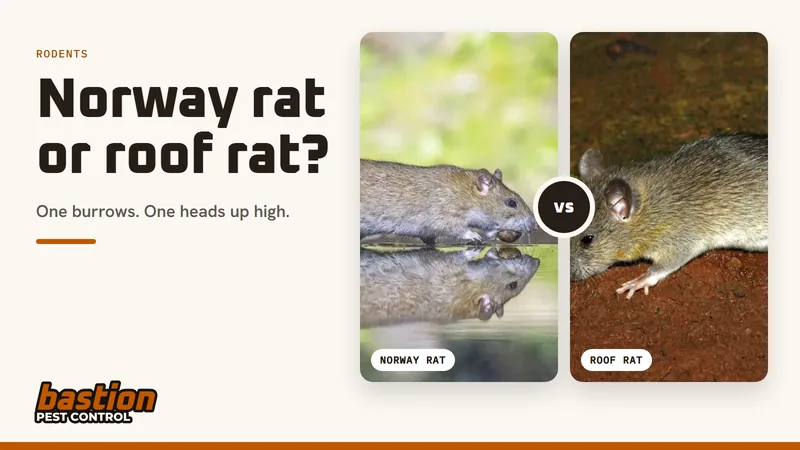
A Norway rat is the big, stocky rat that digs. A rat nest underground is almost always a Norway rat's, Texas A&M says, and their burrows can turn up along foundations and under sheds and woodpiles. A nest up high is usually a roof rat's. Here's how to tell the two apart, read a burrow and keep them out.
Summary
The short answer
A Norway rat is the big, stocky rat that lives on the ground. It's got a blunt nose and a tail shorter than its body. An underground rat nest is almost always a Norway rat's, Texas A&M says. In Travis County, people post photos of about 6 roof rats for every Norway rat, by our count. Your fix is sealing at the base with metal or concrete, then traps or locked bait stations.
Hearing something in your attic? That's more likely a roof rat. See our roof rat guide.
Prefer to listen? 51 seconds.
The short version, read aloud. Read by a synthetic voice, not one of our technicians.
What is a Norway rat, and how is it different from a roof rat?
A Norway rat is the heavier rat that digs, and the roof rat is the slimmer one that climbs better. UC IPM calls the Norway rat a burrowing rodent, usually bigger and stockier than the roof rat. The card below shows you the four spots to check.
Look-alikes
Norway rat or roof rat?

Norway ratAlso called the brown rat
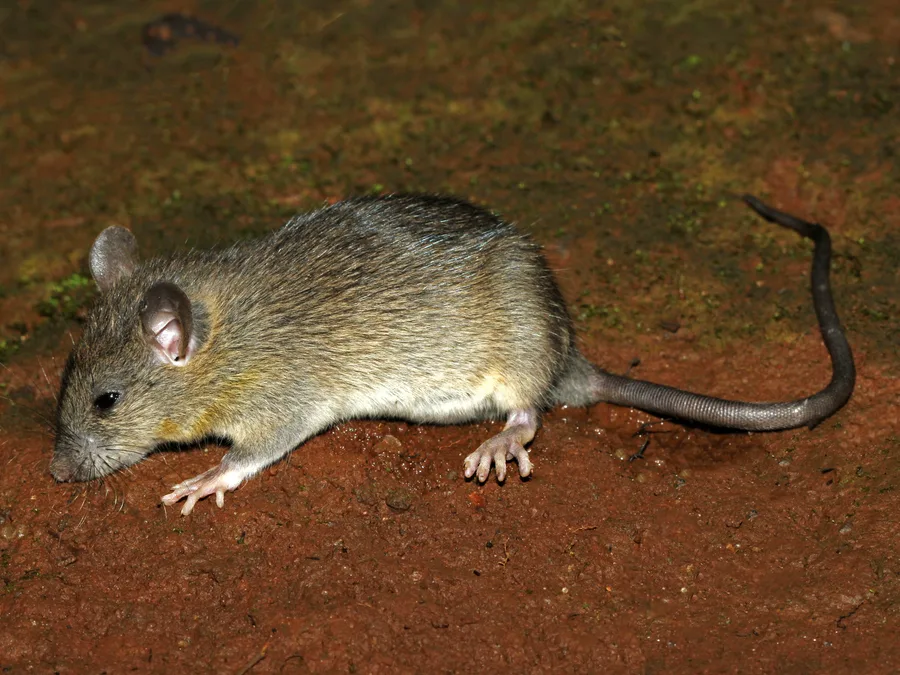
Roof ratAlso called the black rat
| Look at | Norway rat | Roof rat |
|---|---|---|
| Nose | Blunt | Pointed |
| Ears | Folded over, they don't reach the eyes | Long enough to reach the eyes when folded over |
| Tail | Shorter than the body, dark on top and pale below. Pulled over the back, it reaches the middle of the skull | Longer than the body and dark all over. Pulled over the back, it reaches at least the snout |
| Body | Large and robust, 7 to 18 ounces | Sleek, 5 to 10 ounces |
Got a dead one? Pull the tail over its back. A roof rat's reaches at least the snout, a Norway rat's only the middle of the skull. Never on a live one. In a photo, compare the tail with the head and body.
The nest helps too. Up high, you've usually got a roof rat, Texas A&M says, and underground it's almost always a Norway rat.
Rather watch? A New Zealand wildlife biologist shows the tail and ear checks in under two minutes. There, the roof rat's a ship rat.
Not sure which rodent you've got?
Tell us what you found, and you'll get our best guess and whether it's worth a call.
Which one is it?
Which rodent is it?
Pick what you found for our best guess, and whether it's worth a call.
See every answer
- Probably a Norway rat Worth a call
- Texas A&M says a nest underground is almost always a Norway rat. Don't pour bait down the hole. Store-bought bait comes in stations, the EPA says. See rodent control
- Maybe an old burrow Keep an eye on it
- Active holes are clean and clear of debris, ICWDM says. One full of leaves may not be in use. Check back for fresh dirt.
- Probably a roof rat Worth a call
- Texas A&M says a nest up high is usually a roof rat, and roof rats seldom burrow. Norway rats can climb too, so check the tail and ears against the card above. Read the roof rat guide
- Maybe a house mouse Seal and trap
- Norway rat droppings can be up to 3/4 inch long, ICWDM says. If yours are a lot smaller, it may be a mouse. See how mice get in
- Probably not a rat Check what's digging
- A Norway rat burrow has an open main hole, about 2 to 4 inches across, Pests in the Home says. A closed mound doesn't match. See what makes dirt piles
What does a Norway rat burrow look like?
You're looking for a round hole about 2 to 4 inches across, worn smooth, often with fresh dirt fanned out in front. That's the main door, Pests in the Home says, though it can look different by region. There are usually 1 or 2 others you may not notice. And the site puts the tunnels no deeper than 18 inches.
Their burrows may turn up along foundations, under rubbish or woodpiles and around gardens, UC IPM says, and that digging can undermine foundations and slabs. Texas Tech's mammal guide adds burrows under sidewalks and outbuildings, like your shed.
To tell if a hole's in use, check for these:
- A clean hole. Active holes are clear of debris, with rat hairs around the entrance, ICWDM says.
- Worn paths. Rats use the same routes, so check along your walls, fences and under bushes.
- Greasy rub marks. You may see smudges on walls and pipes, from the oil and dirt on their fur.
- Blunt droppings. Up to 3/4 inch long with blunt ends, usually in small clumps.
Dirt mounds with no open hole are probably something else, and our dirt piles guide covers those.
Are there Norway rats in Austin?
Yes, but you'll probably run into roof rats more. Texas Tech says the Norway rat is widespread in Texas but less common than the roof rat in the state's southern half.
Our own count of Travis County iNaturalist photos agrees. In Travis County, people posted about 6 roof rats for every Norway rat, and Texas looks the same. Across the US, it flips: almost 2 Norway rats per roof rat.
Around Austin, most rats people photograph are roof rats
Our count of research-grade iNaturalist photos of the two rats: the share that are Norway rats (orange) and roof rats (gray).
- Norway rat
- Roof rat
It counts photos, not rats. You'll spot a roof rat on a fence a lot easier than a Norway rat in its burrow. And it's small: just 14 Norway rat photos here.
Texas A&M's pest course says wild Norway rats live near woods and streams and commonly follow creeks, ditches and sewers to new areas. Bird feeders, pet bowls, weeds and messy compost bins favor them too, it says.
Can Norway rats make you sick?
Rats can carry flea-borne typhus, but Austin's 2008 study tested too few rats to judge. The Texas health department says rats and their fleas are its natural reservoir. Opossums and pet cats may spread it too, and fleas are the usual carriers.
In Austin's 2008 outbreak, CDC and Texas researchers found antibodies in 12 of 17 opossums, 4 of 9 dogs and 3 of 17 cats near patients' homes. They say that suggests opossums and pets may be part of the cycle. The 4 rats tested were negative, too few to judge, the authors said. Our roof rat guide charts the local cases by year.
How do you get rid of Norway rats?
Seal them out at ground level, then trap or bait the rest. Texas A&M's rat guide calls rat-proofing the most permanent fix, if the cost is reasonable: metal over edges they could gnaw, concrete to stop burrowing under your foundation.
UC IPM says to seal every hole bigger than 1/4 inch, so you keep out mice too. Here's how mice get in. Then:
- Treat fleas first. Do it before rodent control, the Texas health department says, or the fleas leave the dead rats for new hosts, possibly you.
- Seal before you bait outside. That way poisoned rats don't come inside to die, UC IPM says.
- Put stations by the burrows. Or against walls and along their paths. Rats might take days to weeks to use them.
Moves that backfire with Norway rats
- Bait down the hole. Store-bought bait now comes only in ready-to-use stations, the EPA says. Only pellets may go in a burrow, at least 6 inches down an active one.
- Plastic, foam or caulk as the plug. UC IPM says rats can chew through all of them, and wood too.
- Closing a burrow with rats inside. Fill it with concrete or sand only once they're gone, Pests in the Home says. Seal them in and you risk a terrible smell.
Can you handle Norway rats yourself?
Some of it, sure. Take in your feeders and pet bowls, clear the clutter, seal with metal or concrete, and set traps. Pros, the EPA says, have to keep bait in tamper-resistant stations anywhere kids under 6, pets or wildlife can reach.
That's how our rodent control works. Plans cover 40+ pests, rodents included, from $66 a month, with sealed, tamper-resistant stations checked every visit. That lowers the risk, but it doesn't remove it. An active infestation is a separate job from $449, and sealing's quoted on top once we see your house. See our services and cost guide.
Common questions
Is a Norwegian rat the same as a Norway rat?
Yep, it's the same animal, Rattus norvegicus. UC IPM says it also goes by brown rat, sewer rat and barn rat. Whatever you call it, it's the stocky rat that burrows, not the slim one in your attic.
Can Norway rats climb?
Yes, just not as well as roof rats. Texas Tech says they're more at home on the ground but good climbers, and they've been seen traveling along telephone wires between buildings. Indoors, UC IPM says they usually stay on the ground floor, though rats in the ceiling aren't uncommon.
How long do Norway rats live?
Sources don't agree. Texas A&M's rat guide says 1 to 2 years. Its pest course says wild rats typically live 5 to 12 months.
How fast do Norway rats breed?
Fast. Texas A&M says a female has 4 to 6 litters a year, 7 or 8 pups each on average, with the most babies in spring and fall. The young can breed at about 3 months. And UC IPM says an average female can wean 20 or more young a year.
Found holes by your slab or shed?
Call or text 843-480-8699 and tell us where the holes are and what you've seen. We'll look along your slab, shed and fence line and show you what we find.
Phone answered 24/7. Same-day service most days.Sources
- Texas A&M AgriLife Extension Service, Wildlife Services, Managing Rats and Mice, L-1916 (PDF, 6/13)
- Texas A&M AgriLife Extension Service, Public Health License Holders Course, Chapter 8: Rodents and Rodent Control (PDF)
- Natural Science Research Laboratory, Museum of Texas Tech University, The Mammals of Texas Online Edition: Norway or Brown Rat
- Texas Department of State Health Services, Zoonosis Control, Flea-borne Typhus
- Emerging Infectious Diseases, Adjemian, Parks, McElroy and others, Murine Typhus in Austin, Texas, USA, 2008 (2010)
- University of California Statewide IPM Program, Pest Notes: Rats (Publication 74106, updated June 2025)
- Pests in the Home, Cooperative Extension, How Can I Get Rid of Rat Burrows and Holes Around My House?
- Internet Center for Wildlife Damage Management, Norway Rats: Identification
- U.S. Environmental Protection Agency, Restrictions on Rodenticide Products
- iNaturalist, Research-grade observations of Norway rats and roof rats, Travis County, Texas and the United States (our count, pulled 2026-10-14)
Answered 24 hours · Austin, TX
Want the rats handled for you?
Our recurring plans cover 40+ pests, rats included, and start at $66 a month. Call 843-480-8699 and tell us where you're seeing holes, or send us your address for a free quote.