Rodents in Central Texas
Mouse droppings vs rat droppings, and how to read what you found
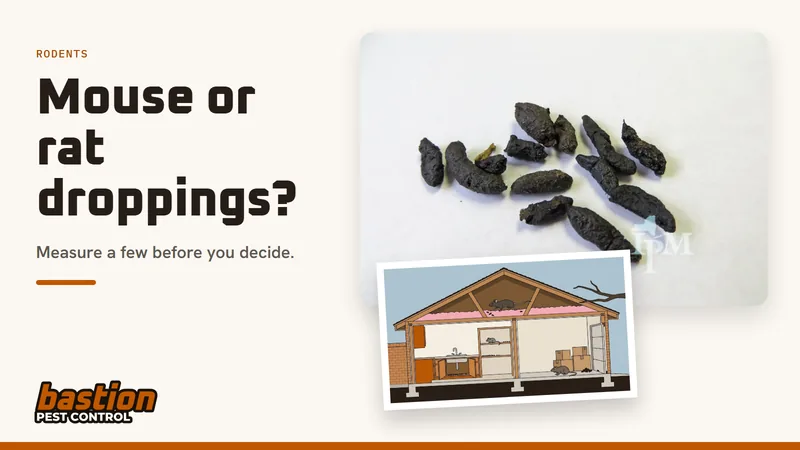
Little pellets in the pantry, under the sink, in the garage or up in the attic? Mouse droppings vs rat droppings mostly comes down to one thing: how long they are. Here's how to tell them apart, and what to do once you know.
Summary
The short answer
Mouse poop is tiny, about 1/8 to 1/4 inch long, with pointed ends. Rat poop is bigger: about 1/2 inch for a roof rat and up to 3/4 inch for a Norway rat. Roof rat droppings are pointed too, so in an Austin attic, go by length, not the ends. Don't sweep or vacuum them, because the CDC says that can put tiny droplets with viruses into the air. Soak them with disinfectant, wipe them up, then check the spot again, since new droppings mean they're still around.
Your checklist is right below. For the rat that lives up high, see our guide to roof rats in Central Texas.
Prefer to listen? 49 seconds.
The short version, read aloud. Read by a synthetic voice, not one of our technicians.
Found droppings? Your step-by-step checklist
Don't sweep them up. Measure them, clean them the wet way, then check back. Telling mouse droppings from rat droppings is the measuring part, and it tells you what you're up against.
Printable checklist
Found droppings? Do this.
Work from the top down, and keep your bare hands off them.
Before you touch anything
Cleaning up, the wet way
Over the next few days
Download the printable checklistPDF, one page
The clean-up steps come from the CDC's guide to cleaning up after rodents, and disinfecting rat droppings takes the same steps as mouse droppings. You can do most of this list yourself. But if new droppings keep showing up, or you find rat-size ones in your attic, call us at 843-480-8699. That's what our rodent control service is for.
Want to see the wet clean-up before you try it? A county health department walks through it in under two minutes.
Mouse droppings vs rat droppings, side by side
Length is the tell: mouse droppings run about 1/8 to 1/4 inch, and rat droppings about 1/2 inch, up to 3/4 inch for a Norway rat. Texas A&M names three rodents that live with or near people: the house mouse, the roof rat and the Norway rat.
Mouse vs rat droppings, drawn to the same scale
Length is what separates a mouse from a roof rat. Both have pointed ends.
- Length. A house mouse leaves droppings about 1/8 to 1/4 inch long, Texas A&M's training slides say. A roof rat's are about 1/2 inch. A Norway rat's can be up to 3/4 inch.
- Ends. Mouse poop and roof rat poop are both pointed. Norway rat droppings are blunt.
- Pattern. Rats leave about 40 to 50 droppings a day, usually in small clumps, ICWDM says on its Norway rat page. Other rodents tend to scatter theirs.
Comparing mouse droppings vs rat droppings? Measure a few, not just one. Cornell's pest program says size varies some, and big and very small droppings side by side can mean you've got both adults and young.
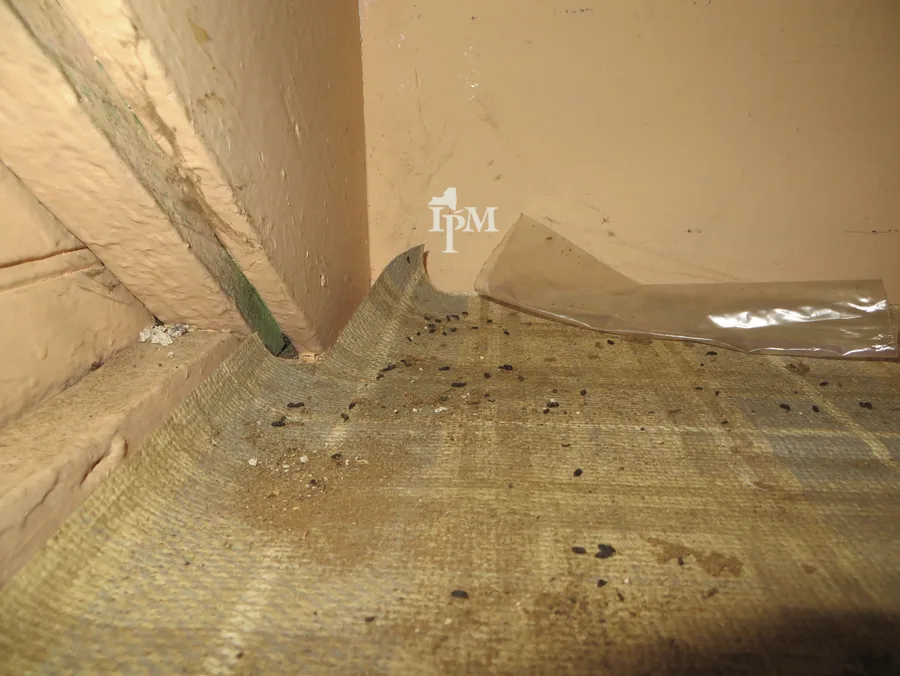
House mouse droppings
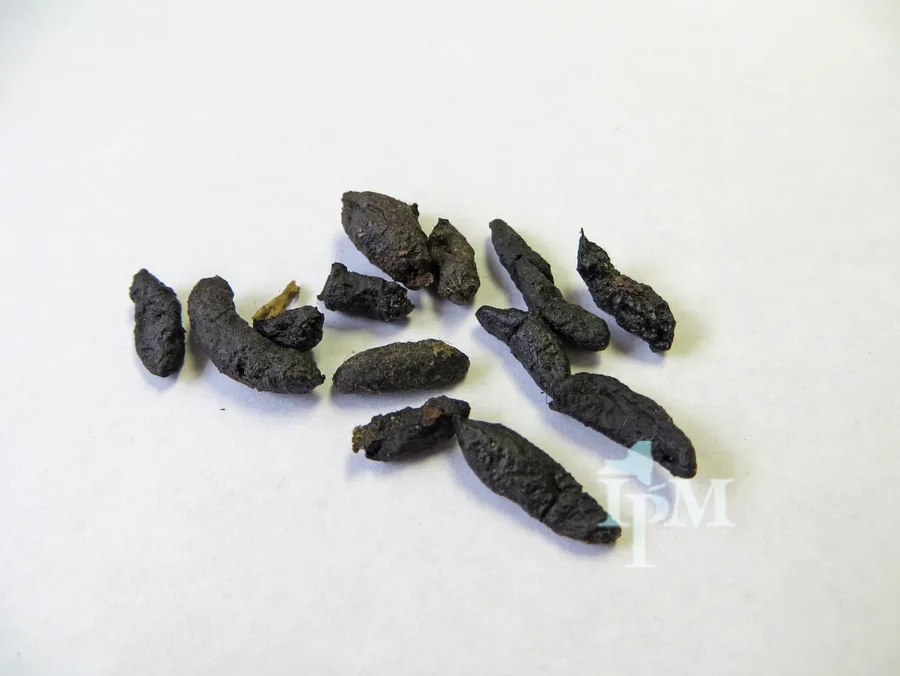
Norway rat droppings, blunt ends
What do mouse droppings look like?
Small, with pointed ends, and about 1/8 to 1/4 inch long. The wildlife damage site ICWDM says house mouse droppings average 1/4 inch. You may find them along the paths mice run, where they eat and near where they hide.
Mice are more common in homes than rats, ICWDM says. They may nest in garages, closets, attics and basements, so small droppings in your attic can still be a mouse. Finding them in the pantry or under the sink? See how mice get in the house.
What do rat droppings look like, roof rat or Norway rat?
About 1/2 inch with pointed ends for a roof rat, and up to 3/4 inch with blunt ends for a Norway rat. Those sizes come from ICWDM's roof rat and Norway rat pages.
Where you find them helps too. Texas A&M's rat leaflet says the roof rat seldom burrows and normally nests in double walls and attics. Norway rats burrow under foundations, floors and rubbish. So you'll tend to find roof rat droppings overhead, and Norway rat poop down at ground level. Our guides cover roof rats in Central Texas and the Norway rats that live at slab level.
Mouse or rat droppings in the attic? What the spot tells you
Finding what look like rat droppings in the attic? If they're about 1/2 inch long, they most likely mean a roof rat, pointed ends and all. Texas A&M says a nest up high is usually a roof rat's. And Texas Tech's mammal guide says roof rats may live near the ground, but usually hang out in attics, rafters and crossbeams. You may also spot a dark smear of grease and dirt along their routes.
Picture this: you climb into the attic for the Halloween bin, and your flashlight finds pellets scattered across the plywood by the hatch. Suddenly the giant yard skeleton is the least scary thing up there, and all you want to know is how long they are.
Here's the catch once you're up in the attic. You'll often read that rat droppings have blunt ends, but that's only the Norway rat. A roof rat's are pointed, like a mouse's. So a pointed pellet on your attic insulation isn't proof of mice. Not sure what you've got? Text a photo of one next to a coin to 843-480-8699, and we can usually tell you what you're looking at.
| Where or what | What it likely means | Why |
|---|---|---|
| Attic or rafters, about 1/2 inch | A roof rat | Texas A&M: a nest up high is usually a roof rat's |
| Pantry or under the sink, 1/4 inch or less | A house mouse | ICWDM: mouse droppings average 1/4 inch and can turn up where mice feed |
| Garage floor or along the slab, up to 3/4 inch and blunt | A Norway rat | Texas A&M: Norway rats burrow under foundations and floors |
| Big and very small ones together | Can mean adults and young | Cornell: mixed sizes can mean adult and young rodents |
| Bits of insects in the pile | Maybe a bat, not a rodent | ICWDM: bat droppings contain bits of insects |
Are the droppings fresh or old?
Your best test: clean the spot, then check it again. New droppings after a cleanup mean whatever you're doing isn't working yet, Cornell's pest program says. So they're still coming around.
Wondering about old rat droppings that look dried out? Good sources say little about how droppings age. ICWDM's Norway rat page says fresh droppings have a soft texture, but please don't test that with your fingers. Old rat poop and dried rat poop get the same wet clean-up as fresh.
Moves that make it worse
- Pinching one to see if it's fresh. The CDC's first step is putting on gloves. Look, don't touch.
- Calling it a mouse because it's pointed. Roof rat droppings are pointed too.
- Vacuuming them up. Already did? Don't panic. The CDC says to just follow its clean-up steps now.
Our own count of Travis County iNaturalist records shows one seasonal pattern in what people post. December to February holds 24% of the house mouse and rat records there, but only 12% of all research-grade records.
Around Austin, winter gets about twice its share of rodent photos
Our count of research-grade iNaturalist records: each season's share of house mouse and rat records (orange) next to its share of all records in Travis County (gray).
- House mice and rats
- All research-grade records
Keep in mind those are photos people chose to post, not a count of rodents, and 118 records is a small sample. Our fall guide covers what the first cold front sends indoors.
Finding new droppings where you cleaned? Call us at 843-480-8699 or get a free quote right here on this page.
Common questions
Are rat droppings dangerous to touch or breathe?
They can be, so don't handle them bare-handed or stir them up. The CDC says rodent diseases mainly spread to people when they breathe in contaminated air. As for hantavirus, a review of Texas health data counted 45 cases of the lung illness it causes from 1993 to 2016, clustered in Northwest Texas, so it does turn up now and then. Think a recent illness came from rodents? Tell your doctor you were around them, the CDC says.
Can I just vacuum up rat droppings?
No. The CDC says don't vacuum or sweep them, because that can put tiny droplets with viruses into the air. Instead, put on rubber or plastic gloves and spray them very wet with a disinfectant or 1.5 cups of bleach in a gallon of water, made fresh. Let it soak 5 minutes, or as long as the label says, then wipe up with paper towels and toss them in a covered trash can.
Do a few droppings mean I have an infestation?
Not necessarily a big one. Even a sudden pile doesn't prove a full-blown infestation, Cornell's pest program says. Texas A&M sizes one up partly by asking: a lot or a few, scattered or everywhere, fresh or old? The clean-and-check test above tells you if they're still around.
Is it okay to leave old droppings in the attic?
Better to clean them up than leave them in your attic insulation. The CDC says to clean up all droppings, and to bag exposed insulation that's dirty with urine and droppings for removal. We treat the area during service. We do not remove or replace insulation. If you have had a long-standing infestation above bedrooms, we will tell you honestly whether it is worth calling an insulation contractor.
Droppings keep showing up?
Call or text 843-480-8699 and tell us where you're finding them. Send a photo with a coin next to one, and we can usually tell you what you've got.
Phone answered 24/7. Same-day service most days.Rather not call? Get your price right here.
Sources
- Texas A&M AgriLife Extension Service, Wildlife Services, Managing Rats and Mice, L-1916 (PDF, 6/13)
- Texas A&M AgriLife Extension Service, Public Health License Holders Course, Chapter 8: Rodents and Rodent Control (PDF)
- Internet Center for Wildlife Damage Management, House Mice: Identification
- Internet Center for Wildlife Damage Management, Roof Rats: Identification
- Internet Center for Wildlife Damage Management, Norway Rats: Identification
- Centers for Disease Control and Prevention, How to Clean Up After Rodents (April 8, 2024)
- New York State Integrated Pest Management Program, Cornell University, Managing Mice and Rats
- The Southwest Respiratory and Critical Care Chronicles, Nugent and Alexander, Hantavirus pulmonary syndrome in Texas: An update covering years 1993 through 2016 (2018)
- Natural Science Research Laboratory, Museum of Texas Tech University, The Mammals of Texas Online Edition: Black Rat
- iNaturalist, Research-grade observations of house mice, roof rats and Norway rats, Travis County, Texas (our count, pulled 2026-10-15)
Answered 24 hours · Austin, TX
Found droppings and want them handled?
Our recurring plans cover 40+ pests and start at $66 a month. An active mouse or rat problem is a separate job, priced on our rodent control page. Call 843-480-8699 and tell us where you found them.