Fall pests in Central Texas
Bugs in fall in Austin, and what the first cold front sends indoors
Bugs in fall in Austin don't follow the calendar. They follow the first cool fronts and the rain behind them. Here's when the first cool nights usually show up, from our own count of 30 years of weather records, which bugs come with them, and what to do before the first one.
Summary
The short answer
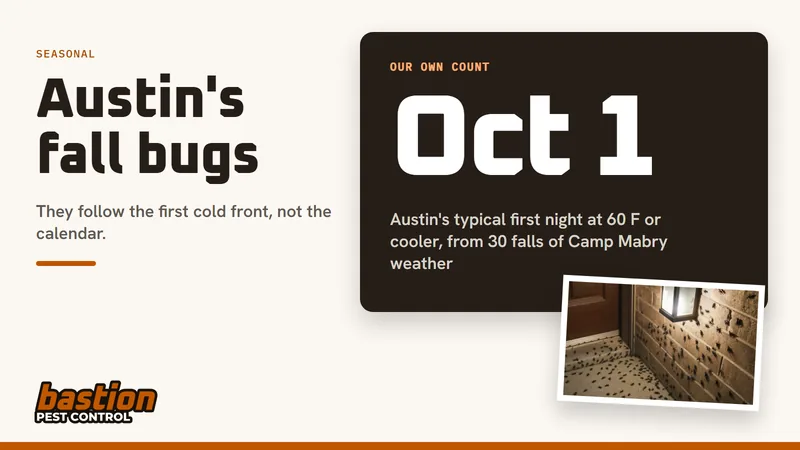
In Austin, bugs in fall show up behind the first cool fronts, not on a set date. In our count of 30 falls at Camp Mabry, the first night at 60 F or cooler usually came around October 1, and the first one at 50 F around October 19. Crickets usually come first, because Texas A&M ties their swarms to those early fronts. Texas A&M says fall rain and cooler weather can push scorpions, millipedes and some spiders inside, and mice often move in as the nights get colder. So do your sealing by mid-September.
For the rest of the year, see our month-by-month Austin pest calendar.
Prefer to listen? 44 seconds.
The short version, read aloud. Read by a synthetic voice, not one of our technicians.
When do the first cool nights reach Austin?
By our count, usually around October 1, but it moves around a lot. We went through 30 falls of NOAA overnight lows at Camp Mabry, 1996 to 2025. The first night at 60 F or cooler usually came around October 1. The first one at 50 F usually came around October 19.
When Austin's first cool nights show up
Our count of 30 falls of NOAA overnight lows at Camp Mabry. One dot per fall; the black tick is the typical date.
- First night at 60 F or below
- First night at 50 F or below
- First freeze, 32 F or below
Some years you get it early, and some years late. The first 60-degree night has come as early as September 7 and as late as October 29. And on average, summer hangs on here: normal highs stay above 90 until September 23, the National Weather Service says.
October is also one of Austin's three wettest months, the Weather Service says. So the first cool, wet week of fall is the one you want to watch.
Which bugs show up first after a cool front?
Usually crickets. They swarm every late summer and fall to some degree, and the timing revolves around cool fronts, says Wizzie Brown, Texas A&M's bug expert in Austin. Crickets don't like heat. They lie low in the heat of the day, and the cool fronts of late summer and early fall change that. The big gathering usually lasts four to six weeks.
If they're piling up around your house, Brown says it's probably the lights. Turn off the ones you don't need. Otherwise the crickets can end up inside, and a pile of dead crickets can stink. Our cricket page covers what we do about them.
Later in fall, you may find tiny specks on your windowsills. They may be hackberry psyllids. Texas A&M says those get inside and collect on windowsills, and they typically show up each fall as it gets cooler. They're harmless, and the best fix is probably just to vacuum them up.
You may see Asian lady beetles, too. They're a classic fall invader. A 2005 study found they fly to buildings in fall once it's warmer than about 70 F, with flights peaking between 2 and 4 in the afternoon.
Why are spiders, scorpions and millipedes inside after a fall rain?
Rain plus cooler weather can drive them in. That's what Brown and Molly Keck, Texas A&M's bug expert in Bexar County, said in 2017 about spiders, scorpions and millipedes. If you're finding scorpions, start with our scorpion guide or scorpion control.
Millipedes live in damp spots under mulch, leaves and rocks, or in the soil. When those spots are right by your house, they can draw millipedes in, and now and then one gets inside, the University of Kentucky's bug experts say. You may see big gatherings after heavy rain. The ones that get in can't survive, so you'll usually find them dead in piles. Sweep them up.
Spiders are trickier, and the FAQ below gets into the myth. If they're bugging you, see spider control.
When do mice start moving in?
When the nights get colder. Where mice live outside, they often move into homes in fall when the nights turn colder, UC IPM in California says. No source gives a set temperature for that. But in our count, Austin's first 50-degree night usually lands around October 19, so by late October, you'll want to start looking.
A mouse can fit through a hole the width of a pencil, about 1/4 inch, the CDC says. Here's where you should look:
- Where pipes and wires come in. The CDC lists these.
- Doors without weather stripping.
- Up at the roof. The CDC says to check among the rafters, gables, eaves and soffits.
Plug small holes with steel wool. It makes a good temporary plug, but it may rust, UC IPM says. For foundation cracks and pipe holes, it suggests metal. Roof rats are their own story, and our roof rat guide covers them. If mice are already inside, that's what our rodent control is for: an active infestation is a separate job from $449, and the sealing is quoted on top once we see the house.
| Bug | When it shows up | What helps |
|---|---|---|
| Field crickets | With the first cool fronts, for about four to six weeks | Turn off extra outdoor lights; tight doors and windows |
| Hackberry psyllids | Later in fall, as it gets colder | Vacuum them; spraying rarely pays off |
| Some spiders, scorpions, millipedes | Can come in after fall rain and cooler weather (Texas A&M, 2017) | Pull mulch back; sweep up millipedes; seal gaps |
| House mice | Often as the nights get colder | Steel wool or metal in 1/4-inch gaps; snap traps |
| Asian lady beetles | Warm fall afternoons | Screens and windows that fit tight |
What should you do before the first cold front?
Seal up, and do it early. Texas A&M says fall is a good time to winterize your house so bugs don't get a way in. In our count, only 2 of 30 falls had a 60-degree night before mid-September, so that's a good target.
Printable checklist
Before the first cold front
Aim for mid-September. Only 2 of our 30 falls had a 60-degree night before then.
By mid-September
When fronts and rain arrive
After a front
Download the printable checklistPDF, one page
If you'd rather watch, Texas A&M's Wizzie Brown walks through the same ideas in this short news clip.
Can you handle bugs in fall yourself, or should you call?
A lot of it is a vacuum and some steel wool. The sealing on the checklist is homeowner work. A few moves just waste your time, though.
Moves that don't help
- Spraying psyllids. Texas A&M says it usually isn't worth it. Vacuum them.
- Spraying millipedes inside. The ones that get in die on their own, Kentucky says. Sweep them up.
- Foam alone in a mouse hole. UC IPM says foam, rubber and wood won't stop a mouse. Use steel wool or metal.
Call us when it doesn't stop:
- Scorpions inside more than once. One is a visitor. If you keep finding them, they're getting in somewhere.
- Mouse droppings or fresh gnaw marks. UC IPM says those show where mice are active.
- Crickets or millipedes still pouring in. If it keeps up after you've sealed, there's probably a gap you haven't found.
- You'd rather not deal with it. That's fair, too.
Our recurring plans cover 40+ pests and start at $66 a month. See our services for what's included.
Common questions
Do spiders really come inside when it gets cold?
Not the way most people think. Seattle's Burke Museum calls that a myth. House spiders are usually different species from yard spiders, it says, and spiders aren't drawn to warmth. In its words, "Generally fewer than 5% of the spiders you see indoors have ever been outdoors." A sudden crowd in late summer is usually males looking for mates. Texas A&M said in 2017 that rain and cooler weather can push some spiders in here, so both can be true.
What are the tiny bugs on my windowsill in fall?
They may be hackberry psyllids, which collect on windowsills. Texas A&M says they typically come in each fall as it gets cooler, they're harmless, and vacuuming is probably the best fix. Spraying them usually isn't worth it.
Should I spray when bugs pour in after a front?
Usually not inside. Texas A&M says sprays usually do little for psyllids, and Kentucky says millipedes that get in die and can be swept up. For mice, UC IPM says snap traps work well in most cases and are a great first step, along with sealing the holes.
Do fall bugs stop once it gets cold?
Don't count on it. In our count, Austin's first freeze usually comes around December 6, well after the first cool nights. The Weather Service puts the 1991 to 2020 average at December 1, which is a different period and method. And the cold sends some bugs looking for shelter: Texas A&M says paper wasps often seek shelter in homes after the first freeze.
Bugs coming in after the first front?
Text a photo to 843-480-8699, or call and tell us what you're seeing and where. We can usually tell you what it is and whether it needs a visit.
Call 843-480-8699 Phone answered 24/7. Same-day service most days.Sources
- NOAA National Centers for Environmental Information, GHCN-Daily, Austin Camp Mabry station USW00013958 (our count, pulled 2026-10-13)
- National Weather Service Austin/San Antonio, Austin Climate Summary (PDF)
- Texas A&M AgriLife Today, Entomologists: South Central Texas residents can expect return of familiar pests (October 2017)
- Texas A&M Stories, Why Crickets Swarm in the Fall (September 2024)
- Texas A&M AgriLife, Texas IPM Program, Fall pest has many South Central Texans seeing spots before their eyes (December 2014)
- University of California Statewide IPM Program, Pest Notes: House Mouse (Publication 7483)
- Centers for Disease Control and Prevention, How to Seal Up to Prevent Rodents (last reviewed April 2024)
- University of Kentucky Entomology, ENTFACT-645: Centipedes and Millipedes in and Around the Home
- Environmental Entomology, Nalepa, Kennedy and Brownie, Role of Visual Contrast in the Alighting Behavior of Harmonia axyridis at Overwintering Sites (2005)
- Burke Museum of Natural History and Culture, Spider Myths: Spiders come indoors in the fall
Answered 24 hours · Austin, TX
Want the fall bugs handled for you?
Our recurring plans cover 40+ pests and start at $66 a month. Text a photo to 843-480-8699 and we can usually tell you what it is and whether it needs a visit.