Pest control in Central Texas
Is pest control worth it in Austin? It depends on the house
Got a pest company's magnet on the fridge and an ant trail by the sink? Then you're probably wondering: is pest control worth it, or would you be paying for nothing? We'll go house by house, including when it isn't worth it. There's a checklist to print, too.

Summary
The short answer
Is pest control worth it? It depends on your house and what keeps showing up. Pest control isn't necessary for an ant trail now and then: wipe it up with soapy water and caulk where the ants get in. Think about a pro when the pest is hard to find or reach, like under a raised floor. If you rent, ask your manager first, since roaches can move between units that share plumbing. And if one fix ends it, you may not need a plan.
Not sure which one is you? Run the checklist below.
Prefer to listen? 43 seconds.
The short version, read aloud. Read by a synthetic voice, not one of our technicians.
Is pest control worth it for your house? Run this checklist
Do I need pest control? Start with your kind of house, because that changes the answer. In our count of Census data, almost half of Austin's housing units (46%) are in buildings of five or more units. And about 6 in 10 Austin households rent.
Printable checklist
Is pest control worth it?
Work from the top down, and skip the checks that don't fit your house.
Before you call anyone
Walk the house
Then decide
Download the printable checklistPDF, one page
When is pest control not worth it?
Do you really need pest control? Not always. NC State says it comes down to what you call a pest and how many run-ins you'll put up with.
- An ant trail now and then. UC IPM, the University of California's pest program, says to wipe it with soapy water to clear the scent trail, then caulk where they come in.
- A one-time problem. NC State says it's your choice whether to treat "reactively (only when you see them)." If one fix ends it, we'd skip the plan.
- A rental where the manager handles pests. Check your lease and ask first.
A homeowner once had the pen uncapped, ready to sign up over one ant trail by the sink. I talked him down to soapy water and a tube of caulk and told him to keep the pen handy.
So is pest control worth it for a bug you see twice a year? Probably not, unless it's termites. Our cost guide lists the small stuff you can skip calling about.
| Your house | How many in Austin (our Census count) | Likely worth it when | Skip it when |
|---|---|---|---|
| Raised house (pier-and-beam) | Not counted. The Census doesn't ask about foundations. | Mice have gotten in under the floor, or the problem is somewhere you can't reach | You've checked under the floor and the vents, they're tight, and nothing keeps coming back |
| Rocky lot | Not counted. The Census doesn't record what's under a lot. | Scorpions keep getting inside after you've cleared rocks and wood and sealed cracks | Nothing gets inside, and you keep rocks, boards and wood away from the walls |
| Newer house, built 2020 or later | About 1 in 15 occupied houses and townhomes | Pests keep finding the gaps where lines come in, or fire ant mounds keep coming back in a sunny lawn | An ant trail now and then that soapy water and caulk take care of |
| Apartment or rental | 46% of housing units are in buildings of 5 or more units. About 6 in 10 households rent. | You own or run the building and roaches keep turning up, since they can move between units that share plumbing | Your manager or landlord already handles pests (check your lease) |
Does the ground under your house change the answer?
Do I need pest control for my house? Start with what's piled by your walls, not with a map. UT Austin's geology bureau says the Balcones Escarpment generally parallels MoPac. Soils west of it are thin and rocky, and soils east of it are deep.
Got rocks, boards or wood near the house? Texas A&M says scorpions hide in small cracks and under stones, bark and wood, and they're hard to control with insecticides alone. So the first step, it says, is changing the area around the house: move the rocks, boards and junk, and seal the cracks.
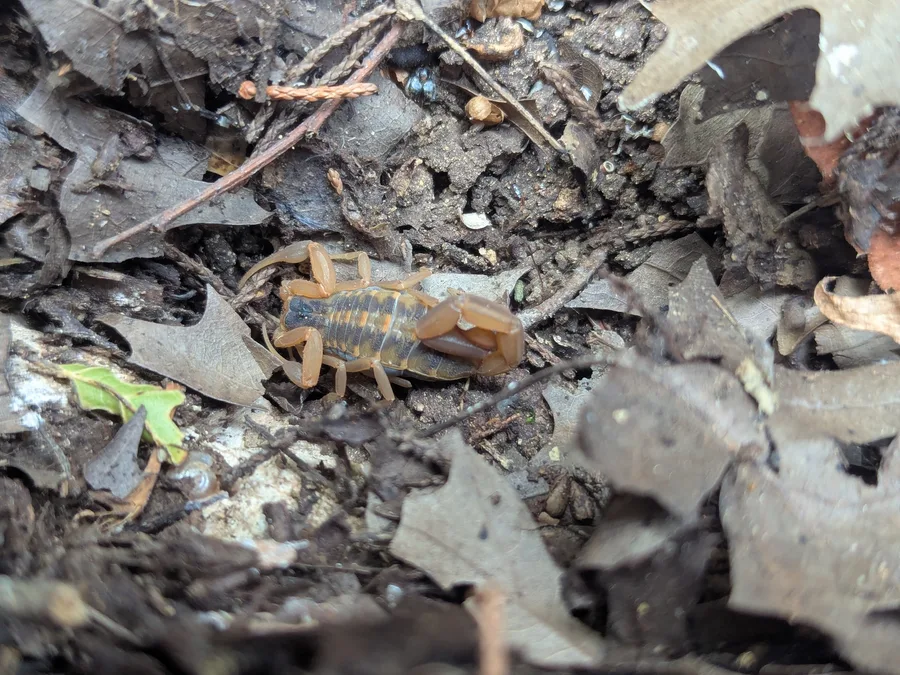
On a rocky lot, a plan alone isn't the fix. Call when they keep getting in after that work, and read up on the two kinds of scorpions found near Austin.
Fire ants aren't picky about the dirt. Texas A&M's fire ant project says they build mounds in almost any type of soil, but prefer open, sunny spots like lawns. So east or west, watch the lawn.
What about an older pier-and-beam house?
Is pest control worth it in a raised house? It's more likely when the trouble is under the floor, where it's hard to see or reach. In our count of Census data, only about 7% of all Austin housing units were built before 1960.
How old Austin's homes are
Our count of Census data: the share of Austin's housing units built in each decade. Orange marks the oldest homes, before 1960, and the newest, 2020 on.
- Built before 1960, or 2020 on
- Built 1960 to 2019
Count just the houses and townhomes people live in, and about 1 in 8 were built before 1960. The Census doesn't ask about foundations, though, so it can't say how many sit on piers.
Under a raised floor, check the crawl space and its vents for gaps, the CDC says. A mouse can fit through a hole the width of a pencil (1/4 inch). NPIC is a pesticide info center run by Oregon State and the EPA, and it says to think about a pro when a pest is hard to find or get to.
Skip the plan if you've checked under the floor and the vents, they're tight, and nothing keeps coming back.
Got a raised house and no wish to crawl under it? Call or text us at 843-480-8699 and tell us what you're finding.
Is it worth it in a new build or an apartment?
Sometimes. New doesn't mean sealed, and an apartment can share pipes with its neighbors.
- A new build. About 1 in 15 occupied Austin houses and townhomes went up in 2020 or later, in our Census count. But the CDC's list of spots to check still includes the holes around electrical, plumbing, cable and gas lines. Skip the plan if all you get is the odd ant trail.
- An apartment. In our count, 94% of households in Austin buildings with five or more units rent. In a 1984 Purdue study of low-income apartments, 75% of the German cockroaches moving into an apartment came from next-door units that shared plumbing. The authors wrote that all that moving around suggests aiming control at whole buildings. So renters, ask your manager first.
When do you need pest control, and when will DIY do?
DIY can work on what you can see and reach. So when do you need pest control? NPIC says to think about a pro when the pest is hard to identify, find or reach, or your own efforts haven't worked.
Still weighing DIY pest control vs professional help? Here's what our pest control service covers: a visit every two months, billed monthly, with 40+ pests on every visit. Bait stations come with the plan, and only a major rodent infestation is a separate job. We treat inside on request at no extra cost, and re-treatments between visits are free. Read up on how often pest control should be done, or see our plan prices.
DIY moves to skip
- Bug bombs for roaches. In a 2019 NC State study of roach-infested homes, foggers failed to cut roach numbers, while gel baits caused significant drops.
- Spraying the ant trail. UC IPM says sprays only give temporary control. Use baits outdoors for the colony.
Tried the fix that fits and it keeps coming back? Call 843-480-8699 or get a free quote right here.
Common questions
Is pest control necessary in Austin?
Not for every house. For the odd ant trail, UC IPM says to wipe it with soapy water and caulk the gap. NPIC says to think about a pro when the pest is hard to find or reach. Around here, that might be under a raised floor, or in a building where units share plumbing.
Do you really need pest control if you rarely see bugs?
Probably not a plan. NC State says most insect pests are just a nuisance, and good pest control starts with a careful look. Keep notes and decide when something keeps showing up. One exception: NC State says jobs like termites are best left to a pro. With us, termites are their own job, priced after we see the house.
Is DIY pest control as good as hiring a professional?
Sometimes, if it's the right product for the right pest. In the 2019 study, gel bait cut roach numbers and bug bombs didn't. But if the pest is hard to identify or reach, or your own efforts haven't worked, NPIC says to think about a professional.
Is a one-time treatment enough for my house?
It can be, if one fix ends the problem. Scorpions are the hard one: Texas A&M says they're difficult to control with insecticides alone, so clear the rocks, boards and junk and seal cracks first, whether you hire anyone or not. For roaches in a building that shares plumbing, the 1984 study suggests aiming control at the whole building, not one unit, so ask your manager first. With us, an active roach infestation is a separate job. We do one-time treatments, priced per property and per pest, but only recurring plans include free re-treatments. Here's how a plan compares with one-time visits on cost.
Want a straight answer for your house?
Call or text 843-480-8699 and describe what you're seeing. We can usually identify it over the phone.
Rather not call? Get your price right here.
Sources
- Texas A&M AgriLife Extension Service, Brown, Scorpions: Identification, Habitat and Control in Texas, ENTO-PU-032 (May 2022)
- Texas A&M AgriLife, Texas Imported Fire Ant Research and Management Project, Biology
- The University of Texas at Austin, Bureau of Economic Geology, Central Texas (GeoWonders)
- NC State Extension, Crawley, Waldvogel, Alder and Hayes, Tips on Selecting Pest Control Services (2017, reviewed January 29, 2023)
- University of California Statewide IPM Program, Rust and Choe, Pest Notes: Ants, Publication 7411 (updated October 2012)
- National Pesticide Information Center (Oregon State University and U.S. EPA), Do It Yourself Pest Control (updated December 1, 2025)
- Centers for Disease Control and Prevention, How to Seal Up to Prevent Rodents (April 8, 2024)
- Journal of Economic Entomology, Runstrom and Bennett, Movement of German Cockroaches (Orthoptera: Blattellidae) as Influenced by Structural Features of Low-Income Apartments (1984), doi:10.1093/jee/77.2.407
- BMC Public Health, DeVries, Santangelo, Crissman, Mick and Schal, Exposure risks and ineffectiveness of total release foggers (TRFs) used for cockroach control in residential settings (2019), doi:10.1186/s12889-018-6371-z
- U.S. Census Bureau, American Community Survey 2024 1-year estimates, Austin city (our count, pulled 2026-10-25), tables B25034, B25024, B25003 and B25127
Answered 24 hours · Austin, TX
Still on the fence about a plan?
Tell us what kind of house you have and what you've been seeing, and we'll give you a straight answer, even if it's that you don't need us yet. Call or text 843-480-8699.