Indoor flies in Central Texas
Fungus gnats around the houseplants, and why they get worse in winter
Tiny dark flies around the pothos? Those are probably fungus gnats. If you've got gnats in the house and they hang around the pots, here's what they are, how to tell them from the other tiny flies, why they get worse in winter and how to stop them.
Summary
The short answer
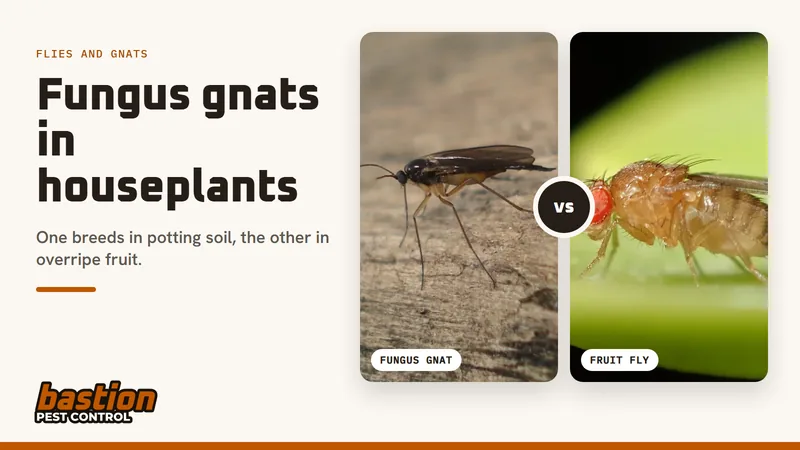
Fungus gnats are tiny, dark flies that look like little mosquitoes, 1/16 to 1/8 inch long, and their larvae live in damp potting soil. Texas A&M says houseplant infestations are most common in the winter months, when overwatering is more common. The fix starts in your pot: let the top 1 to 2 inches of soil dry between waterings, and dump standing water. In a bigger pot, a potato slice in the soil shows you if larvae are there. And they don't bite, but sprays or fogs won't solve it, Texas A&M says.
Not sure what you've got? Try the photo card and picker below.
Prefer to listen? 49 seconds.
The short version, read aloud. Read by a synthetic voice, not one of our technicians.
What are fungus gnats?
They're tiny, dark flies that look like mini mosquitoes, and they breed in damp potting soil.
Look-alikes
Fungus gnat or fruit fly?
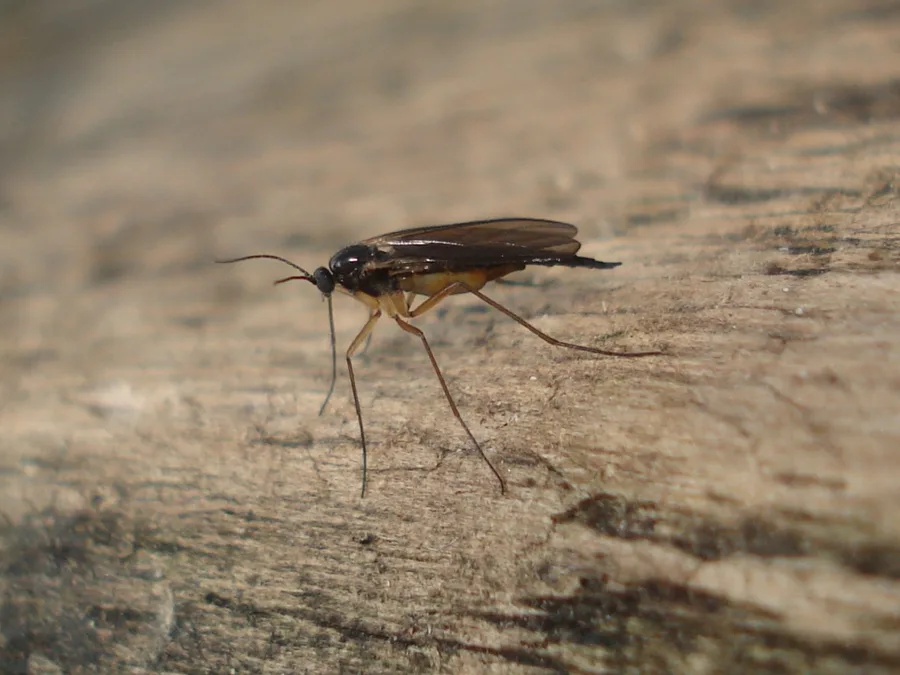
Fungus gnatBradysia, a dark-winged fungus gnat
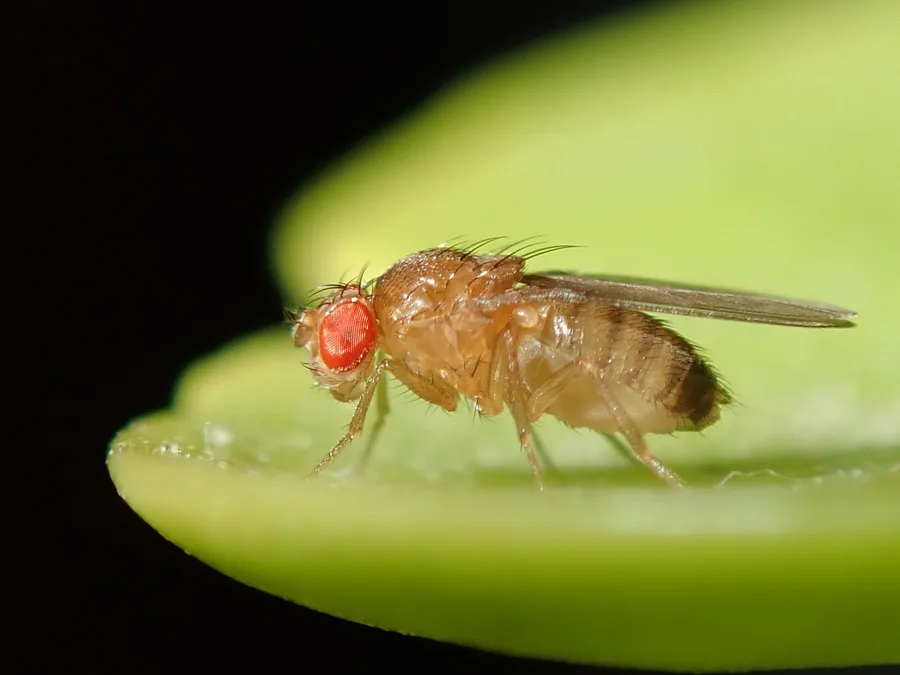
Fruit flyDrosophila melanogaster
| Look at | Fungus gnat | Fruit fly |
|---|---|---|
| Body | Slender, like a tiny mosquito | Stout, with a cylinder-shaped body |
| Antennae | Like a string of beads | A feathery bristle at the tip |
| What stands out | Long, thin legs, and wings that are clear or dark | Eyes that are usually reddish |
Their larvae are about 1/4 inch long, white and legless, with shiny black heads. They eat roots, or the fungus growing in your soil.
Do they hurt your plants? Mostly they just bug you. But in big numbers the larvae can damage roots and stunt growth, especially in seedlings and young plants, UC IPM says. And if a plant's drooping, water trouble or root rot is more often to blame.
Picture this: a gray January afternoon, a video call with your boss, and one tiny dark fly that keeps darting across the screen like it has something to add. You swat at it twice, miss twice, and now the whole call has watched you lose to a gnat.
Is it a fungus gnat or a different tiny fly?
Where you see them is your best clue. Around the pots? Probably fungus gnats. By the fruit bowl or trash, think fruit flies. By a sink drain, think drain flies. Each kind likes a slightly different spot, so Texas A&M says to name the fly first.
Which one is it?
Which tiny fly is it?
Pick where you see them most for our best guess and what to do next.
See every answer
- Probably fungus gnats Dry out the soil
- They most often come up out of houseplant soil, Texas A&M says. Let the top 1 to 2 inches dry before you water again, and dump any water sitting in the saucer. The rest of the fix is on this page.
- Probably a fruit fly Find the fruit
- Fruit flies are stout and usually have reddish eyes. At home they breed mostly in overripe or damaged fruit, bananas especially, and in spoiling vegetables, Texas A&M says. Toss the soft fruit and take out the trash.
- Probably a drain fly Check the drain
- Drain flies look fuzzy and moth-like, and they usually fly only a few feet at a time. Lay clear packing tape across the drain without covering the whole opening, and check it now and then. Flies stuck to it mean that drain is a source, Texas A&M says.
- Maybe fungus gnats from the drain Try the tape test
- Some fungus gnats may also feed on the film inside drains, the same as drain flies, Texas A&M says. Lay clear packing tape across the drain without covering the whole opening. Flies stuck to it mean that drain is a source.
- Maybe a hackberry psyllid Vacuum them up
- Texas A&M's bug expert in Travis County said in 2017 that this tiny fall bug is often mistaken for a gnat. They get inside and collect on windowsills, and she said they're harmless and vacuuming is probably the best fix. Kentucky says they may come in through window screens, and they may probe your skin but don't feed on people. Fungus gnats are drawn to light too, though, so check any pots nearby.
- Probably springtails Not a fly
- Springtails have no wings and don't fly. They jump like tiny fleas, they sometimes turn up in potted plants, and they don't bite, Texas A&M says. See springtails
- Hard to tell from here Worth a call
- Call or text 843-480-8699 and tell us what you're seeing. We can usually identify it over the phone. See what the plan covers
One twist: some fungus gnats may also feed on the film inside drains, like drain flies do. So a gnat by your sink isn't always a drain fly.
If you see gray specks hopping on wet soil, those are probably springtails, which jump instead of fly. They don't even have wings, Texas A&M says.
Why are there gnats in the house in winter?
Because that's when your potting soil tends to stay wet. Texas A&M says these houseplant infestations are most common in the winter months, when overwatering is more common.
Colorado State says shorter days and cooler temps slow how fast a plant grows and uses water. If you keep watering like it's summer, the soil stays moist, and that helps the gnats.
In our count of U.S. Naval Observatory sun data, an Austin December day averages 3 hours 50 minutes less daylight than a June day.
An Austin December day averages 3 hours 50 minutes less daylight than a June day
Our count of U.S. Naval Observatory sunrise and sunset times: the average daylight each month, in hours and minutes. Winter months are orange.
- Winter months
- The rest of the year
The larvae usually live in the top few inches of wet soil, so if you're hunting houseplant bugs, start there. In some cases a new bag of potting soil brings them in, Texas A&M says. For the rest of the year, check our month-by-month Austin pest calendar.
How do you get rid of fungus gnats?
Dry out the top of your soil and take away their wet spot. Texas A&M says the only real fix is finding where they breed and getting rid of it.
- Check the pot. In a bigger pot, push a 1/4 inch slice of peeled potato into the soil. Any larvae will move to it within 24 to 48 hours, Colorado State says.
- Add a sticky card. A yellow card at the pot's edge catches adults. On its own, it won't cut their numbers much.
- Let the top dry. Water only when your plant needs it, and let the top 1 to 2 inches dry first. A dry surface kills eggs and larvae. Dump the saucer, too.
- Still flying? Once they're a problem, drying alone may not be enough, Texas A&M says. You can treat or replace the pot and soil, or move the pots outdoors.
No larvae in the potato, and the flies keep coming? Call or text us at 843-480-8699 and tell us what you're seeing. We can usually identify it over the phone.
Skip these
- Fogging the house. Don't fog indoors or spray gnats in the air, UC IPM says. Aim at the soil, where they spend most of their life.
- Caterpillar Bt. It doesn't work on fly larvae, but Bti can, UC IPM says.
Do Mosquito Bits work on fungus gnats?
They can, on the larvae in the soil. Mosquito Bits are Bti granules, and the EPA-accepted label has directions for gnat larvae in house plant soil.
Sprinkle 1 to 2 teaspoons on a small pot (6 inches across or less) or 1 tablespoon on a bigger one, and water it in. If gnats come back within 3 weeks, do it again. Or soak 4 tablespoons in a gallon of water for 30 minutes and skim off the granules. Water the soil with it weekly for three weeks. Follow the label on your own bag, and read its CAUTION line: harmful if inhaled or absorbed through the skin, and it causes moderate eye irritation.
Bti works on the larvae that eat it, so the adults already flying hang around until they die off. Young larvae are hit hardest, says NPIC, a pesticide info center. And in a 2006 lab study, a Bti drench did nothing to larvae in their second and third stages. So start early, and repeat it the way your label says.
Can pest control get rid of fungus gnats?
For gnats in a houseplant, the real fix is in the soil. Sure, gnats are on the list our plan covers. We treat outside by default, and inside when you ask, at no extra cost. But the larvae live in the pot, and sprays won't solve that, Texas A&M says.
A visit makes sense when the flies may not be from a pot: tiny flies in rooms with no plants, or no larvae in the potato. Our plans from $97 a month are billed monthly and cover 40+ pests on every visit. Here's how a visit every two months works.
Tried all that and they're still flying? Call 843-480-8699 or get a free quote right here.
Common questions
What's the best way to get rid of gnats in the house?
Figure out which tiny fly it is first, because each kind likes a slightly different spot. Then take that spot away. For fungus gnats, Texas A&M says finding and getting rid of the breeding spot is the only way, and for fruit flies it's essential. The picker above can help you sort out which one you've got.
Are the gnat-like bugs all over the window screens fungus gnats?
Maybe not, especially in the fall. Wizzie Brown, Texas A&M's bug expert in Travis County, said in 2017 that the hackberry psyllid is often mistaken for a gnat. They get inside and collect on windowsills. She called them harmless and said vacuuming is probably the best fix. Kentucky's bug experts say they may come in through screens and usually vanish after a killing frost. They may probe your skin, which feels like a tiny bite, but they don't feed on people or pets. Fungus gnats head for light too, so check any pots nearby. Here's more on what the first cold front sends indoors.
Do fungus gnats bite people or pets?
Adult fungus gnats don't bite or feed at all, Colorado State says. UC IPM says they don't bite people. They're just annoying, like when one keeps drifting in front of your face or your screen.
Will fungus gnats go away on their own when winter ends?
Don't count on the calendar. Indoors they can turn up any time of year, UC IPM says. What matters is wet soil: letting the top dry kills eggs and larvae, Colorado State says. And moving the pots outdoors can end an infestation from potted plants, Texas A&M says.
Still seeing gnats after the soil dries?
Call or text 843-480-8699 and tell us where you see them and what they look like. We can usually identify it over the phone.
Phone answered 24/7. Same-day service most days.Rather not call? Get your price right here.
Sources
- Texas A&M AgriLife Extension Service, Merchant, Indoor Flies and Their Control, ENTO-050 (PDF, 5/16)
- Texas A&M AgriLife Today, Schattenberg, Entomologists: South Central Texas residents can expect return of familiar pests (October 6, 2017)
- Texas A&M AgriLife Extension, Insects in the City, Merchant, Springtails, ENT-2011
- University of California Statewide IPM Program, Bethke and Dreistadt, Pest Notes: Fungus Gnats, Publication 7448 (updated August 2013)
- Colorado State University, Department of Agricultural Biology, Fungus gnats
- University of Kentucky Entomology, Townsend, Hackberry Psyllids and Other Jumping Plant Lice, ENTFACT-413 (revised March 2026)
- U.S. Environmental Protection Agency, accepted label for Mosquito Bits, EPA Reg. No. 6218-86 (Summit Chemical Company; amendment accepted December 13, 2021) (PDF)
- Pest Management Science, Cloyd and Dickinson, Effect of Bacillus thuringiensis subsp. israelensis and neonicotinoid insecticides on the fungus gnat Bradysia sp nr. coprophila (2006), doi:10.1002/ps.1143
- National Pesticide Information Center (Oregon State University and U.S. EPA), Bacillus thuringiensis (Bt) General Fact Sheet (reviewed May 2022)
- U.S. Naval Observatory, Astronomical Applications Department, sun data for Austin, Texas, 2026 (our count, pulled 2026-10-21)
Answered 24 hours · Austin, TX
Tiny flies that won't quit?
For gnats in a pot, the fix is the soil. If tiny flies keep coming anyway, call or text 843-480-8699 and tell us what you're seeing. We can usually identify one over the phone.